
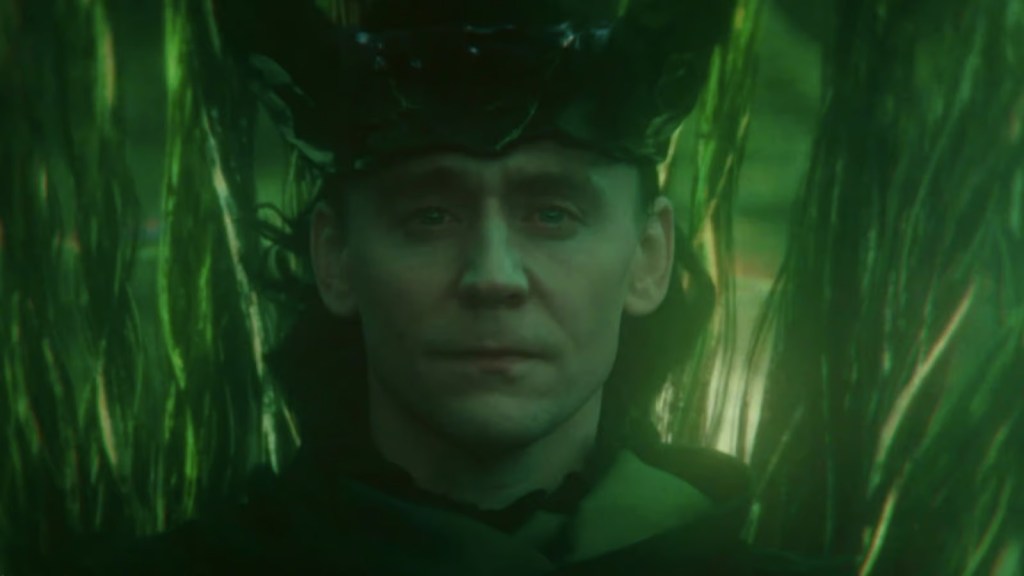
“Loki” might be the best project to come out of the Marvel Cinematic Universe’s Phase 4 and 5, with its Season 2 finale, “Glorious Purpose,” cementing that.
Much has been written about how these stories — in both film and TV — have become generic clusterf**ks filled with bad CGI, too many characters and unbalanced storylines sometimes mangled by controversial reshoots. The MCU has found out the hard way that it can’t pump out a stream of projects on autopilot anymore, with its good will that it rightfully earned after “Avengers: Endgame” starting to dissipate.
Its move to split some of its mainstream projects into Disney Plus TV shows has been publicly criticized by its CEO, Bob Iger, for diluting the brand, and he might be right. But moreso, shows like “WandaVision,” “Moon Knight,” and this show have outshone especially some of the company’s more lackluster cinematic outings.
Episode 6 “Glorious Purpose” sees the titular Loki (Tom Hiddleston) find just that: His purpose in life. This will supposedly be the final episode of the show (I don’t see where it can go from here; spoilers), as we wrap up a character arc whose seeds were sown in the very first “Thor” film 12 years ago.
After his initial failure to get Kang variant Victor Timely (Jonathan Majors) to adjust the “loom” keeping the Time Variance Authority from being wiped out by the expanding multiverse, Loki eventually learns how to control his timeslipping, giving him an infinite amount of tries to get it right.
He optimizes his fortune as much as he can, even absorbing all the engineering knowledge of Ouroboros (Ke Huy Quan) over centuries of tries in order to get it right. But he learns that the TVA is supposed to fail no matter what he does, which drives him to go back to the moment when Sylvie (Sophia Di Martino) kills He Who Remains (Majors).
He Who Remains laughs at him, knowing exactly what went wrong and that the demise of the TVA is inevitable. It forces Loki to reflect on what he wants and is willing to do to save his friends, as well as all the lives of the multiverse.
Loki started his character arc in “Thor” wishing to ascend to the throne of Asgard, ignorant of its responsibility and burdens. He eventually gets to the point where he recognizes that he doesn’t need a throne in “Thor: Ragnarok,” before he is killed in “Avengers: Infinity War” selflessly trying to save his brother, Thor, from Thanos.
“Loki” the series follows up on the Loki variant that escaped in “Avengers: Endgame,” giving the character a second chance not only at life, but to resolve his character arc in a different way. Instead of dying nobly, Loki decides to replace the temporal loom and, using his powers, hold the multiverse together himself, essentially becoming the God of Stories as depicted in one of his comic runs.
He’s at the point where a throne is the last thing he wants — he just wants his friends — and it is at that moment he finally receives his, as protector and guardian of the multiverse. It’s a much nobler and more fulfilling conclusion for him than his “Infinity War” exit, one that sees him grow beyond self sacrifice and into a life of service.
Marvel’s Phase 4 and 5 films have yet to deliver any tale close to this riveting — and “Loki” also looks better than most MCU projects these days, thanks to its tight direction, use of great physical sets for the TVA and strong characters.
This is also one of the few MCU projects that took full advantage of its television format; this does not feel like a two-hour movie stretched far beyond that.
“Loki” is a unique show that sees its antihero protagonist develop beyond what he — and perhaps us — thought possible. Its time travel and other science fiction elements are reminiscent of “The Umbrella Academy” and “Doctor Who,” yet the show manages to feel uniquely its own, despite how much it borrows from works in its genre.
“Loki” has set the bar high for Marvel.
“Loki” Season 2: Episode 6 “Glorious Purpose” gets a 9/10





Leave a comment