
In my years of reading sci-fi and fantasy tales, and especially books that blend the two genres, I have run into stories that are so spellbinding that they stay with you for the rest of your life, as well as stories that might be decent, but end up being sadly forgettable. And then there
are tales that, while they have grained acclaim and have many positive traits, they have nevertheless evoked mixed emotions in me. This is not necessarily a bad thing, mind you, but in this day and age, where fantasy stories have been enjoying a resurgence in popularity, this has
resulted in a mix of outcomes story-wise—specifically a market that is nearly flooded with books of varying quality.
Nowadays, this has arrived at the point where being spoiled for choice becomes just as much bane as blessing. For a person like myself, whose literary tastes are, for lack of a better term, persnickety in the extreme, it makes finding a book that sparks my interest more difficult, as many books that have popped up in the years since this aforementioned resurgence only exist to chase trends. And while I have no issue with authors and readers who do this, I prefer to look for books based
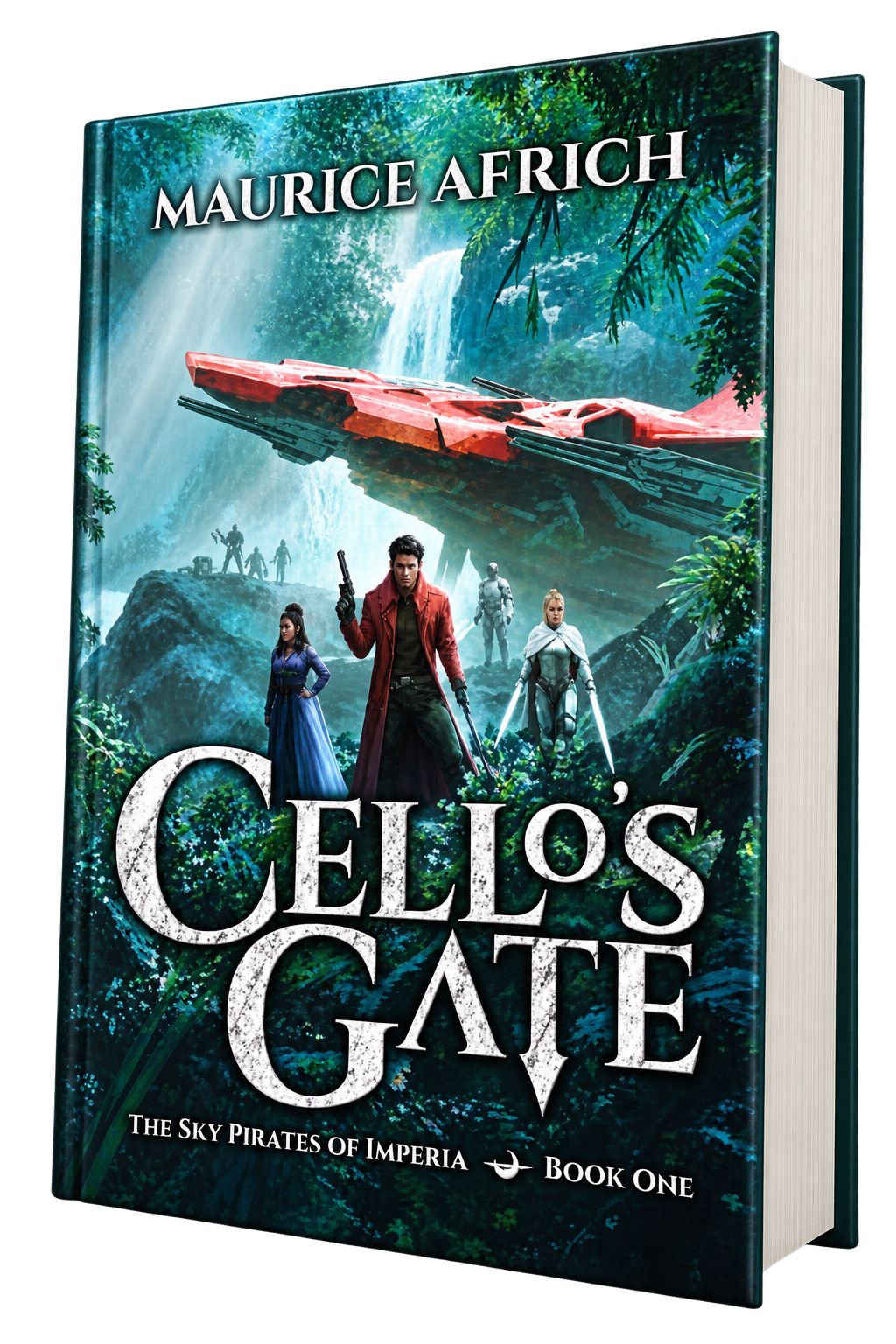
on what I like rather than what is trendy. And even then, this may lead me to a book that speaks to me at first, but in the end, leaves me with, shall we say, mixed emotions. This is what happened to me after reading Cello’s Gate, the first book in The Sky Pirates of Imperia, by Maurice Africh.
The fact that the story is a near-seamless blend of sci-fi and fantasy was the first thing that piqued my interest, along with the glowing and enthusiastic reviews I saw both on Amazon and YouTube. Imperia is a world lousy with advanced Star Wars-esque tech like airships, energy weapons, and shields, as well as magically gifted individuals blessed with psychometry, dimensional shifting, attunement with nature … and immortality. And though this first globetrotting adventure doesn’t have many ports of call, there is still a rich history that fuels the tale of Grey Shimada, sky pirate extraordinaire and captain of the airship Trench.
The first thing the reader will find familiar Africh’s premier work is the not-so-subtle similarities to Guardians of the Galaxy in terms of character relationship dynamics, giving the Trench’s eclectic crew the feel of a makeshift family of ne’er-do-wells whose survival lies in their extraordinary talents and diverse personalities. Grey, as captain, is naturally the glue that binds the team, after he was, for all intents and purposes, forced into the disciplines that made him into a capable and yet reluctant leader. Minn and Farlow are a duo of siblings and Grey’s childhood friends, who make up the heart of the team, with Minn’s powers of an Oracle and the nebbish Farlow’s invaluable medical expertise. Willow and Bones, never without a snide remark, comprise the team’s piloting and tech experts, while Mars and Dot serve as the muscle of questionable mental stability and/or humanity, with Mars having been rescued from the horrible tortures of life in underground bloodsports and Dot trained from childhood into the almost robotic killing machine that is a Crescent Knight (Think Jedi, but remove compassion and
empathy, but with the same indestructible energy sword).
Grey is given the unenviable task of herding this group of proverbial cates into a surprisingly effective team. This has earned them the reputation of being some of the best among sky pirates, able to get the job done with a cool head, even when things go pear-shaped,
as they often do. And it is this well-earned reputation that has attracted the attention of Dalia, the daughter of the immortal archgoverness of the integrated cities of Imperia. She presents Grey and his crew with an irresistible mission: retrieve a set of legendary stones that shouldn’t even exist, for a heretofore unknown purpose. With an exorbitant payout that reeks of desperation and in spite of distrust born of immortals robbing Grey of his childhood, the wily captain and company are
directed by Dalia, who is an immortal herself, to the faraway—and supposedly cursed—island of De Gaté, where machines stop working, and a deadly foe awaits with traps and secrets that he is
anything but willing to divulge.
The course of this tale gives an action-packed adventure filled with discovery and danger of Indiana Jones proportions. But the heart of the tale lies in the crew dynamic. Each character’s features and foibles create unique interactions between them. Grey’s clearheaded calm keeps Willow focused and puts even the taciturn Dot at ease, allowing her to channel her Crescent Knight conditioning towards beneficial functions. There is also Grey and Minn’s perpetually unresolved, will-they-won’t-they romantic tension throughout the story. The crew of the Trench has the feel of a family, even when circumstances separates them, and exposes each to the life-threatening dangers of death traps, wild animals, and the underlings of immortal dictators with magic paranoia, all in a quest to retrieve an objective that may or may not be a legend. But the true discovery leads to something even more bizarre.
Of course, I would be remiss if I did not touch on the story’s fantasy elements. Imperia is a world of technology, but also where godlike beings left their indelible mark, displayed in special powers given at birth to random individuals in the form of oracles, intangibles, imperials, and immortals. Oracles like Minn possess the ability to read the history of people and objects with a touch; intangibles bend space to teleport and pass through solid objects, making them incredibly effective spies and assassins; Imperials possess a link to nature, allowing them to
cause plants to grow to an incredible extent, and immortals, true to their moniker, cannot die, and comprise most of Imperia’s government heads. Even Crescent Knights seem to have honed their own physical abilities to superhuman levels. And those who use magic are met with varying levels of acceptance, from godlike reverence to execution on sight.
Though there is much to like about this book, reflected in the rave reviews of other readers, I found a different experience during the course of my reading, which, though not entirely spoiling my enjoyment, did somewhat hamper my experience in a few ways. And this is chiefly due to matters of pacing. The story grinds down to “stop and smell the roses” at inopportune times. And while this didn’t destroy my interest in this otherwise fast-paced tale, it did make things occasionally sluggish to the point of distraction. Moreover, while Africh’s worldbuilding is intriguing, Imperia feels only marginally explored, with the majority of this tale taking place on two or three locales, and only for the first few chapters, leaving the lion’s share of the story on De Gaté Island. But as the book presents an extensive map of Imperia at its beginning, I feel that it’s safe to assume that much more of this world will be brought to light in later books. This is hinted at nearer to the beginning, in fact, as Dalia gives an explanation heavy (and rather unnecessary) pre-mission description of the world for Grey and his crew, during which, one very unpleasant locale is given a more thorough expository overview than the everything else, perhaps foreshadowing what to expect later.
And so, while other reviewers have been singing the praises of this introduction to the world of Imperia and its eclectic family of sky pirates, my experience has given me cause to take a slightly more cynical, but not unkind approach to my review. While presenting a world that is indeed intriguing with its blend of sci-fi and fantasy and a band of treasure-hunting misfits that cannot help but give strong Guardiand of the Galaxy vibes, I feel that the story takes its first steps into what is hinted to be a magnificent world with perhaps a bit too much trepidation, making reading an occasionally frustrating experience. Nevertheless, in the book’s well-deserved defense, there is absolutely a fun story to be enjoyed here.
Despite its flaws, for those looking for a fantasy/sci-fi blend with an exciting treasure hunt, and a crew with a strong family dynamic in a world that hints at many yet-to-be-revealed wonders and dangers, you can certainly do far worse than this. Despite my unusually high amount of criticism, I did not dislike this book. And it still kept me curious as to what awaits Gray and company in the next tale. So, pick it up for yourself, and see if, warts and all, it ends up being just as intriguing for
you.
7/10; recommended with reservations





Leave a comment