
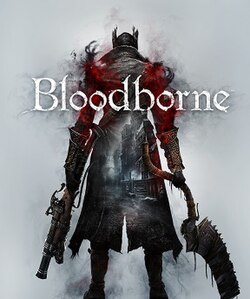
Dark Souls 2 may very well be my favorite, but Bloodborne was my foray into the Soulsborne franchise. This took place back in 2019, which would have been just before the pandemic and still a few years before Elden Ring came out. Here we are, several years later and, just like what inspired my series of Dark Souls 2 articles a couple weeks ago, the on-going Return to Yharnam event has inspired this one. At the time of writing, this year’s ‘RTY’ just began yesterday.
Bloodborne released in 2015. It’s eleven years later, and fans continuously beg for a port or even a remaster. Why is that? Let’s assess this game’s pros and cons, beginning with the former.
Central Yharnam/Beginning of the game

Here’s a controversial statement for you right off the bat. Bloodborne is a truly wonderful game with many strong aspects that we’ll be getting to, but I would contend that the game truly peaks right from the start, and not in a bad way. Central Yharnam is an amazing area for newer and more experienced players alike. The map layout is just fantastic, featuring a few really cleverly placed shortcuts, nifty hidden loot and even a couple of places with some exciting combat. There aren’t strategic dilemmas placed upon the player quite like arriving at a huge bonfire (no, not a Dark Souls bonfire, an actual bonfire), seeing a legion of enemies surrounding it and blocking your way forward, and mapping out how the heck you plan to deal with it.
Again, while the game is generally fantastic and it doesn’t have many genuinely weak parts of the game akin to the second half of Dark Souls 1, the very beginning is perfect for making sure players get hooked right away.
Weapon Quality
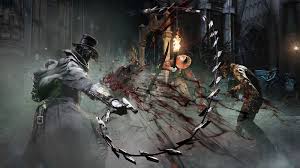
I made a similar claim in Dark Souls 2, that there generally aren’t any bad weapons in that game for the most part, other than joke choices From Software clearly intended to suck. However, Bloodborne takes the quality over quantity approach to an even greater extreme than Dark Souls 2. There are far less weapons in this game than any other Soulsborne title, but in return, each weapon is actually quite good. Even the slightly underwhelming picks, like the Saw Spear can absolutely put in work. With the potential exception of the Torch, there aren’t any tools in this game in general that serve as joke entries. Everything has a place.
It isn’t just that each weapon is good too, all of them have their own unique movesets along with unique, fleshed out animations. Where other Soulsborne entries have subcategories of weapons, like distinguishing between a sword and an axe, that doesn’t exist in Bloodborne. Weapons are confined to certain stat builds, but otherwise, they’re all trying to do their own thing.
“Starter Weapons”
In any other From Software game, the player has dozens of options for what weapon they’d like to begin the game with. Usually, there’s a blacksmith, a merchant, probably both, who are near the beginning of the game and are selling a handful of different weapons. Something for everyone.
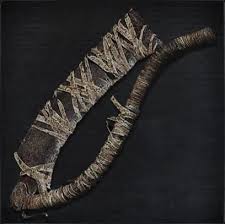
Bloodborne does not handle the player’s first weapon in this way. The player is initially prompted to choose between three weapons: the Hunter’s Axe, the Threaded Cane and the very weapon seen on the cover of the game and pictured above, the Saw Cleaver. Enemies in this game cannot drop weapons, and there are no Boss Souls, which significantly simplifies the early-going in terms of weaponry.
Having said that, while the system may seem bland and simplistic, I argue that it serves to supplement the weapon quality discussed earlier. As well, I’m a Pokemon player, and while the “three starter” system is handled very differently in that game, the faint traces of DNA from that franchise have caused each of this game’s starters to develop their own cult followings. You’ve got your “Charmander”, the iconic Saw Cleaver that’s by far the most well known and typically the most explosive. Then, you’ve got your “Bulbasaur”, the Hunter’s Axe, a fine weapon without any clear shortcomings who can clear the first portion of the game very, very easily and never really runs into a problem it can’t solve. Finally, you’ve got your “Squirtle”, the Threaded Cane and my personal favorite, the least flashy of the three and least statistically exciting, but containing a number of lesser known benefits that can be very useful to a smart player.
No, you don’t have any rival choosing a different weapon who invades you later (though that would probably have been really cool, if not out of context) but the way Bloodborne handles the ‘starting weapon’ is overall positive.
Pace of Play
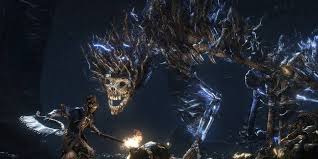
The crown jewel of Bloodborne and what truly distances it from the rest of the franchise is its pace of play. There are only two shields in Bloodborne, the game literally memes and makes fun of one of them and the other isn’t available until extremely late in the game. So, if you can’t dodge or better yet, parry, you are in for a rude awakening. However, in learning to adapt to these conditions, you get a game which is even faster than Elden Ring, rewards calculated aggression more than any game in the franchise, and overall leads to some frankly incredible gameplay moments.
This game does have more of a learning curve than the average Souls game as a result, but it is all worth it in the end.
Gothic/Morose Niche
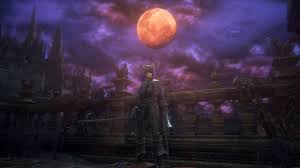
Bloodborne and Dark Souls 3 both tried to create drab, dark, dreary worlds. Bloodborne’s is far more distinct because it had a much clearer focus, aiming to replicate a gotchic horror atmosphere into a Soulslike gameplay climate. Granted, this is subjective, and there are people, even Souls fans, who will not enjoy the niche Bloodborne occupies. But, Bloodborne’s atmosphere is so distinct and specific, that I’d envision this game, not any of the Dark Souls trilogy, not Sekiro, not even Elden Ring, to be the game that stands the test of time years, even decades down the road, the best. Bloodborne set out to do its very own thing, independent from the rest of From Software’s catalogue.
It should be worth noting that, while indeed BB and DS3 had similar plain, surface level aesthetics, Bloodborne’s direction was vastly different. Dark Souls 3 just tries to create a dying, decaying, unraveling world. Bloodborne wants to create a plagued ridded, madness induced, ferally dangerous world. The two can intersect at times, but Bloodborne is far, far more distinct and also isn’t constantly trying to depress the player either.
Forsaken Castle Cainhurst

This place is awesome. When I mentioned earlier that the game does generally peak at the beginning, I was hesitant to fully commit to the notion that the game truly, objectively, never gets any better than it does at the start, and Cainhurst Castle is precisely why. This is not only the best area in all of Bloodborne hands down, it belongs up there as one of the best areas ever seen in a From Software game.
Cainhurst Castle has everything. The layout is flawless, there are a number of completely unique, interesting enemies to deal with, cool loot, the area is relevant to multiple NPCs and a covenant and, best of all- an amazing fight with Martyr Logarius at the rooftop of the castle.
Bloodborne was developed under some duress, it ultimately had a rough time on launch and, most notably, this game was developed by essentially a skeleton crew, produced exclusively for PlayStation. As such, though the game is incredibly strong, it does have some flaws to discuss. Let’s begin.
Core Resource Management

In this game, Blood Vials take the place of the Estus Flask. As well, Quicksilver Bullets become another crucial resource, as the player needs ammunition for their gun, however they plan to use it. Generally, you will find yourself using the gun a lot, which is why the Quicksilver Bullet item usage is uniquely tied to its own button press unlike non-Blood Vial items.
On paper, nothing about this looks flawed, except in how the player is meant to manage their Blood Vial count. In other Souls games, the Estus Flask regenerates all of its charges automatically when the player rests at a checkpoint, so there is never a part where the player must buy Estus Flask charges, nor will any enemies drop Estus Flask charges to them in these games.
In Bloodborne, you are basically on your own. You get no free Blood Vials upon resting at any checkpoint, so you have to buy them yourself or get enemies to drop them. There do actually exist very early opportunities to reliably ‘farm’ these resources, but even still this creates unnecessary tedium that can slow the game down. It would almost assuredly have been better for the player to get their 20 Blood Vials, stay at 20 until consuming some, then get back to 20 upon resting at a Hunter’s Lamp checkpoint somewhere. Oh, and speaking of this so-called ‘resting’…
Bonfires and Graces > The Lamp
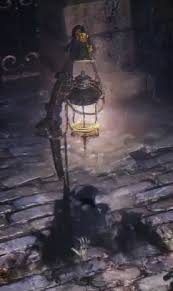
In other Souls games, the player can rest at the Bonfire or Site of Grace. This effectively ‘pauses’ the game, but it also respawns enemies all over the world with some nuanced exceptions and, generally, resets the area for the player.
This is one of those aspects you take for granted until playing Bloodborne, when the mechanic is removed entirely. In Bloodborne, you cannot ‘rest’ at a lamp. You can only use lamps to fast travel between areas in the game. While fast traveling does respawn enemies the same as resting, resting does not force a loading screen on the player the way fast traveling does. This may not seem like much, but over the course of a lengthy playthrough, this will serve to significantly slow the game down.
This also ties in with my previous con thoroughly. The player will find that they’ll need to ‘farm’ for necessary resources, such as Blood Vials. The best early game way to do this is going to Central Yharnam, going down two immediate flights of stairs, then taking a slight left to encounter two Rock Trolls. These trolls pretty reliably drop two Blood Vials on defeat, when they aren’t wasting your time with Shining Coins instead. The problem is, the player must reload Central Yharnam over and over again to continuously kill these Trolls. In any other Souls game, they could just rest at a Bonfire to respawn them. Over the course of a long playthrough where Blood Vials will likely need to be repeatedly farmed, this flaw in game design will really start to seep through.
The fast travel itself isn’t even that good, as the player cannot go from lamp to lamp in Yharnam, they must first return to the Hunter’s Dream, where only then can they be selective on where else they’d like to go. This adds yet another loading screen to the equation, which will start to really add up as the playthrough goes on.
Overall, Bloodborne was my first Soulsborne game. You never forget your firsts. Back then and even now, this is a very enjoyable game for me. I don’t put it on Dark Souls 2’s level, but I’m still inclined to give this game an A- for a grade. It is a brilliantly fun time so long as you’re willing to be patient with some of its less noticeable shortcomings.

 InReview
Leave a comment