
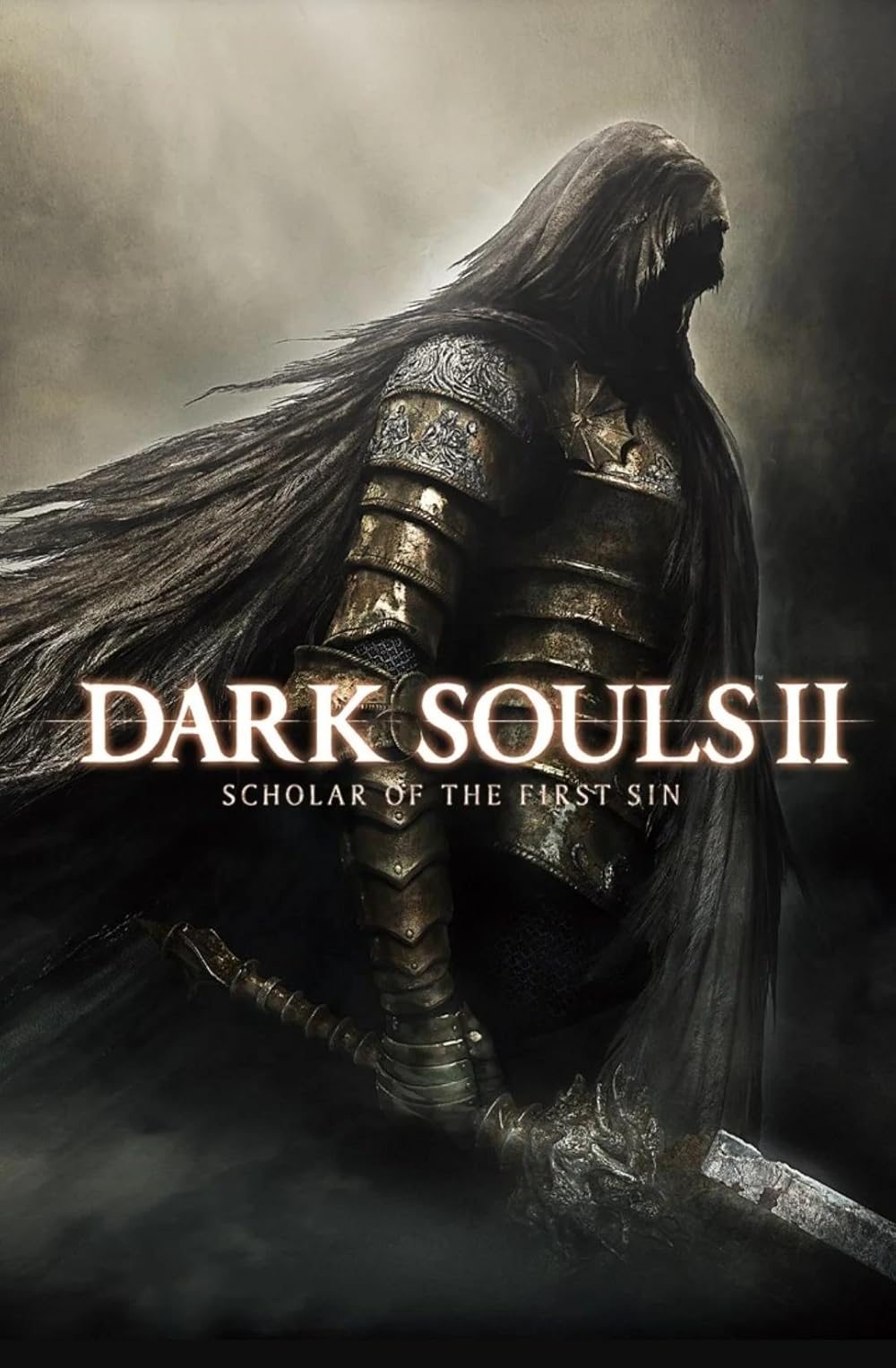
Recently, I revealed my personal all-time favorite ten games I’ve ever played. Dark Souls 2 made the list. At the time of writing, later this week will see the annual fan-made Return to Drangleic two week event commence. The older Souls series has annual “Return to-” events where players from all around the community make a new character and engage with the game again as if it was brand new. This is a fascinating phenomenon that isn’t officially recognized by From Software themselves, but is so routine that it may as well be considered a federal holiday. For Dark Souls 2, this takes place from February 27th and lasts into mid March.
I’ve partaken in several Return to Drangleic events before. I’ve done some pretty wild stuff in the game in general, achievements like beating the entire game eight times in a 24 hour period, beating parts of the game blindfolded and even doing a Broken Sword playthrough. This year, I find myself partaking in it as usual, but I’d also like to contribute my first ever “Mega-Review” of the game in the process.
InReview has never done a “Mega-Review” before, so here’s how it’s going to go. Every single remotely mentionable trait about this game, for better and worse, will be thoroughly fleshed out. The review isn’t assessing every single pixel to be had in the game per se, so it’s not like some kind of strategy guide. But if it’s even slightly worth mentioning, even if it seems obscure, this review plans to cover it.
So, let’s begin with a bountiful list of things that make this game absolutely amazing.
Majula
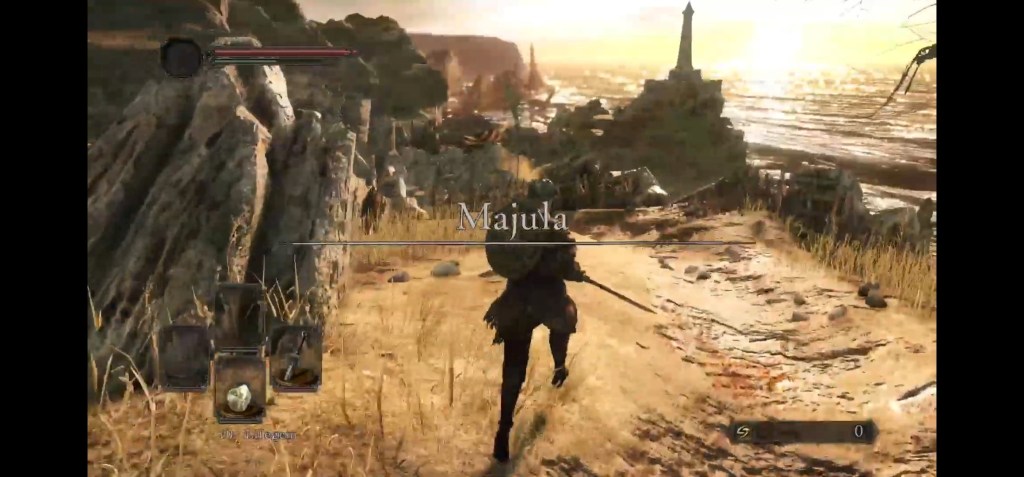
Even people who hate this game can’t help but love the game’s central hub. This is arguably the best hub in the entire Soulsborne franchise. It perfectly captures the feeling of a small village, with numerous inhabitants, infrastructure and, of course, a beautiful ocean to peer out into. Like many other areas in the game, there is so much more to Majula than the hefty amount that already meets the eye. There’s hidden loot, unique NPC interactions, the player can tamper with the environment in some fun, captivating ways, and the area’s soundtrack is just amazing. The way it connects with and gently pushes the player to explore other parts of the game is handled almost as amazingly as the Firelink Shrine from the first Dark Souls. When people refer to Elden Ring as “Dark Souls 2 II”, a huge part of the reason involves just how seamlesly connected Majula is to other major parts of the game. Without using any bonfires, the player has three, soon four different paths they can take from Majula leading to loads of base game content.
Forest of Fallen Giants
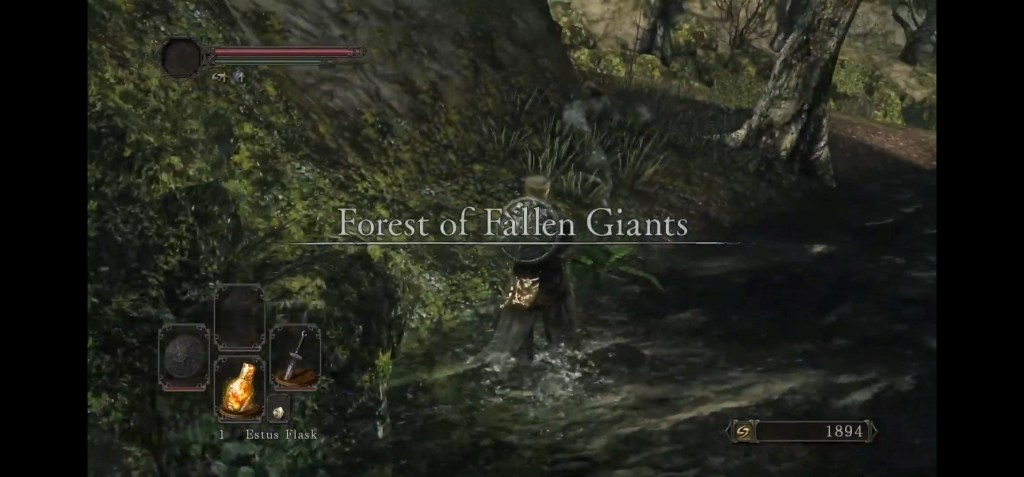
The Things Betwixt area probably deserves the label of a ‘tutorial’ area more than this place does, but this place is the best, most cleanly structured ‘first area’ in all of Souls. There are clever yet intricate shortcuts to open the area up, loads of hidden secrets and enemies which have been very well balanced for the context of a player beginning their playthrough.
This area boasts two bosses which, on paper seem basic and lacking in any nuance, but in actuality have a surprising amount of depth. One of them is The Last Giant, the boss players typically slay first. At a surface level, this boss is fantastic to help new players adjust to the flow of the game. At a narrative level, this boss will actually be re-encountered later when the player goes in the past. Said time travel adds a lot of really cool context to the fight, both gameplay and narratively speaking. The second boss fight is with The Pursuer. This one is really cool because of the environment around him. He can uniquely be fought outside of his boss room early in the level as a one-time appearance. If the player would rather take the fight to his abode, though, they’ll find a few ballistae in the room that they can use to shoot the big man down. The ballistae can friendly fire and kill teammates extremely easily though. All of these elements have served to make The Pursuer memorable wherever he is fought.
Because of how the game flows, players will find themselves collecting a few key items later in the game, then returning here to use said key items. Because of this, Forest of Fallen Giants isn’t actually mandatory to do until the player is nearly finished with the game. This distinction is truly unique and offers players the opportunity to incorporate a twist into their playthrough. Plenty have faced The Last Giant as a first boss, but how about a funny playthrough where you save him until nearly the end of the game? It might be funny to see how quickly you could kill him. Alternatively, because some very important, but not mandatory things are unlocked when beating him, one could concoct a challenge run where they put The Last Giant off for this reason.
Finally, this area is where the NPC Merchant Hag Melentia is met. Melentia’s wares are varied and unique unlike any other merchant, but most vitally, she sells infinite quantities of Life Gems. Life Gems have to be the best, most valuable consumable in all of From Software history. More on that to come later. The ability to have Melentia return to Majula and sell them right at the game’s hub is largely at the front of players’ minds when deciding to come to the Forest of Fallen Giants.
Drangleic Castle
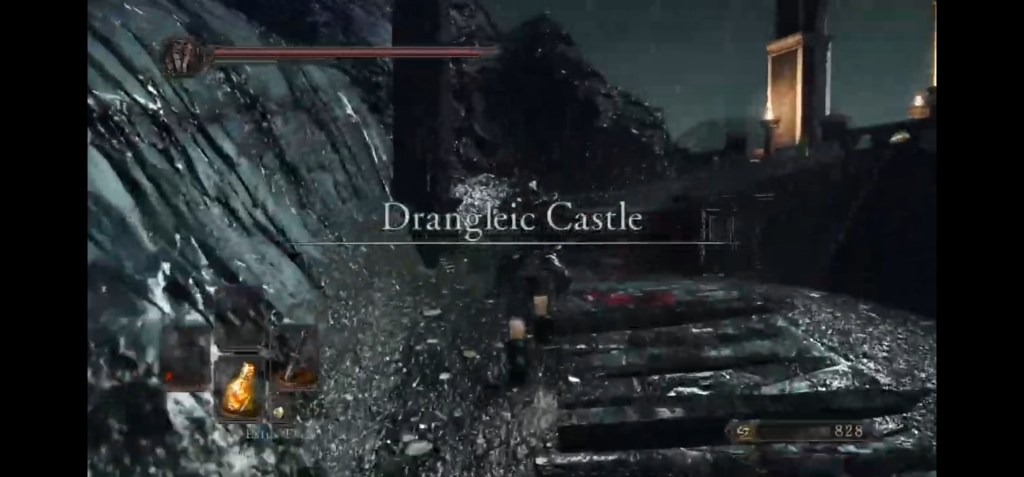
This has to be the sharpest looking, most well structured area in the entire base game. It boasts nice enemy variety, the pouring rain aesthetic fits the grand structure surprisingly well and, just like Forest of Fallen Giants, the player comes to this area initially, leaves, later finds important key items, then has to return here to further progress the game. It is here where the base game’s final boss fight takes place, but when initially arriving, the player will be in a roughly mid-slightly late game state with still plenty of content left to experience.
By far the most iconic part about Drangleic Castle simply has to be the ridiculous elevator positioned right in front of the King’s Passageway. In the game’s lore, Drangleic King Vendrick enslaved and forced a squadron of giants to construct this elevator. I was fortunate enough to capture a perfect, short video describing just how magnificently ridiculous this elevator is. Viewer discretion is advised for coarse language used.
DLC Areas/Bosses
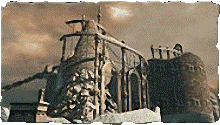
My personal favorite would probably have to be Brume Tower, but Shulva the Sanctum City and Eleum Loyce are amazing in their own ways too. The DLC ramps up the difficulty a fair bit, and each area is quite long and intricate. These should be viewed more as dungeons than as areas, especially Shulva, as they are just that vast in addition to walled off from the base game.
Brume Tower has some of the best boss fights, not just in this game, but in all of Souls. Fume Knight is the boss players have died the most to in all of Dark Souls 2, but Sir Alonne is just as sturdy a challenge and a tough fight with the “Blue” Smelter Demon awaits as well.
Shulva has some excellent boss fights as well, and the scenery is beautiful. It is an abandoned underground city with a giant dragon inhabiting it. Aesthetically, it draws players in before they’ve even reached the first bonfire.
Eleum Loyce is incredibly distinct as the game’s only snow area. Like Shulva, this is a mostly abandoned city loaded with secrets and replayability. A genuinely thrilling, masterfully crafted boss fight against the Burnt Ivory King awaits. Out of nearly 200 bosses, the Burnt Ivory King found himself at #3 on our boss ranking list from long ago.
Aesthetic Equipment
When people label Elden Ring as “Dark Souls 2 II”, this is often one aspect that gets looked at. The “drip” in this game is just amazing, and lends itself to a variety of different interests. There are also a number of cool weapons, some with neat secondary effects; this was basically Dark Souls 3’s Weapon Art system as an Alpha, with that system essentially functioning as a Beta for Elden Ring’s Ashes of War.
While there is plenty of cool armor and melee weaponry, magic casting was not left out by any means. There are some really visually impressive Pyromancies in particular, but the Hex, Sorcery and Miracle catalogues all have something to offer that both performs well and looks really cool too.
Player-versus-Player Combat
PvP in Dark Souls 3 is amazing. PvP in Elden Ring, for as great as the game is, leaves a bit to be desired. In Dark Souls 2, the crisp, unpredictable nature of Elden Ring PvP exists, but at the far preferable pace of play seen in a Dark Souls 3. While there are ‘meta’ builds like any other video game in existence, the game is extremely well balanced and there aren’t any legitimate strategies that will cause a player to lose or fail by default.
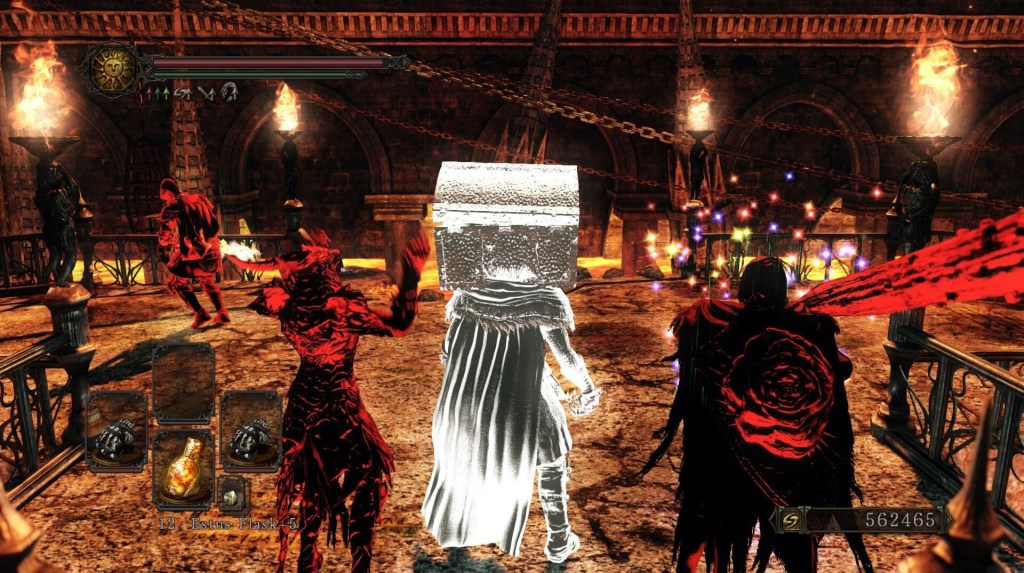
In particular, during the upcoming Return to Drangleic, keep your eyes open when traversing the Iron Keep, Aldia’s Keep or the DLC’s Eleum Loyce. These are PvP hotspots where action is quick and the fights are good.
Even the random NPCs have personality…
By far the highlights would be Devotee Scarlett and “Chad”ley of the “Bro” Guard, but even NPCs with zero narrative impact that have no voicelines have a funny, quirky personality to them. Each of them has its own distinctive AI that makes them act in ways which are memorable. Devotee Scarlett is an absolute powerhouse who would throw herself on a live grenade to protect the host. The aforementioned Bradley will heal the player if they summon him and are not at full health. The Head of Vengarl, for better or worse, will actively pick a fight with nearby enemies even if the player doesn’t share his interest. Of course, how could anyone neglect to mention Lonesome Gavlaan’s “wheel and deal” mantra? There are enough unique summonable NPCs and their quirky interactions to fit an article by itself. This doesn’t even take into account the NPCs with actual narrative importance, such as the all-time iconic Lucatiel of Mirrah or Aldia, the titular Scholar of the First Sin. That segways well into the next topic…
…But the important NPCs leave a lasting mark too!
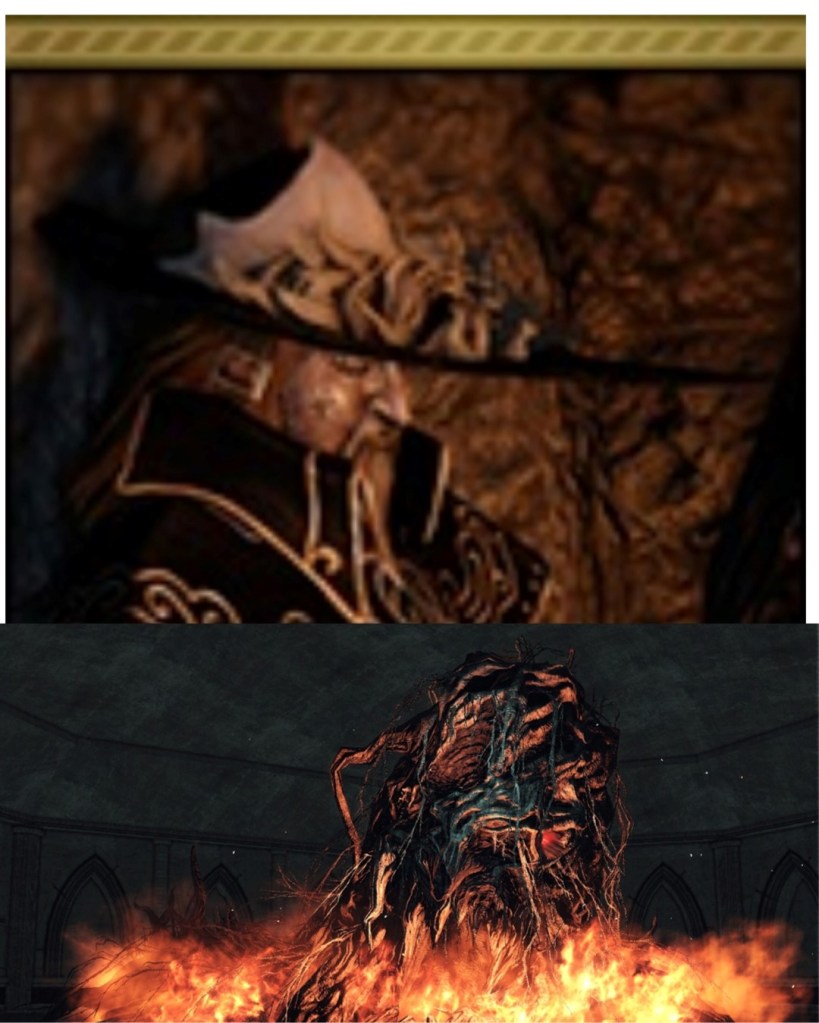
Lucatiel of Mirrah, Aldia, King Vendrick, the Emerald Herald, Lenigrast and Steady Hand McDuff, I could go on. The main cast and crew of this game was great narratively and had immeasurable impact gameplay wise as well.
Life Gems

Life Gems are the happiest of happy little accidents in a game loaded full of them. Life Gems were intended to be a supplementary source of healing, to be an emergency choice for if the player ran out of Estus Flasks. Funny story is, due to how Life Gems work, they are almost strictly superior to Estus Flasks and end up assuming the lead healing role, with Estus falling to the wayside. Life Gems may be arguably most responsible for making this game a fair bit easier than the rest of the franchise, but they also hold the game together and making what shortcomings it does have far, far more forgivable. Personally, Life Gems are my favorite aspect about this game from a gameplay perspective. This is why people actually know who Merchant Hag Melentia even is, as she is the only merchant in the game to sell Life Gems in infinite quantities!
Pace of Play
This is more of a subjective take, but Dark Souls 2 came before an era of brain rot TikTok, Generative AI permeating art forums and the ridiculousness two Trump administrations have brought out of society. As such, this game is a lot slower than Elden Ring and even Dark Souls 3, but it is slower in an appreciable way. It isn’t slower in the sense that loading screens take longer to push through, but rather in that there aren’t any “Deal 100,000,000 damage to one shot the end game boss!” YouTube videos out there, Ashes of War that delete entire healthbars in PvP don’t exist, stamina regeneration is slow and movement is on the slower side too with no spectral horse for travel, so mobility isn’t as conked as Elden Ring or even close.
Yet, this slower, methodical type of gameplay definitely suits some players more. As well, it isn’t gushing with dopamine that will eventually stop exciting players, so it’s less gimmicky in general too.
Deathless/No Bonfire Run Incentive

This is still somehow the one and only game in the entire franchise to reward players for going a whole playthrough without taking any deaths or resting at any bonfires. The rewards themselves are fun novelties and, while the ability to turn weapons in your hand entirely invisible isn’t the most gamebreaking thing ever, it’s distinct enough of an effect to provide an actual incentive.
Tangible Changes to New Game Plus
Dark Souls 1, Demon’s Souls and, disappointingly, Elden Ring do not change in any way apart from making enemies stronger when proceeding to New Game Plus. Dark Souls 3 adds a small amount of new equipment to New Game Plus iterations, but that’s it. Dark Souls 2 offers new equipment on NG+ similarly to DS3, but it also changes entirely how some areas and even boss fights occur. Some areas, such as the Forest of Fallen Giants or Iron Keep gain new enemies or invaders. It’s at its most noticeable traversing Brightstone Cove Tseldora, when The Duke’s Dear Freja boss appears suddenly and abruptly to attack the player; this boss isn’t seen for another two whole areas during the first playthrough!
This added meaningful replayability to Dark Souls 2 and gave new life and genuine intrigue to areas players may have already combed through a dozen times over. It’s such a shame this type of effort hasn’t made its way into a Soulsborne game since. This segways into the next subject…
Bonfire Aesthetics

Even now, playing Elden Ring and occasionally going back to Dark Souls 3, these games undeniably boast better all around boss rosters than DS2, but this is another instance in which DS2 was just well ahead of its time with the Bonfire Aesthetic mechanic. Bonfire Aesthetics essentially take the area they are being used in, and shift that area specifically into the next New Game Plus cycle without forcing the player to actually go to NG+. This can let the player get another copy of some pieces of equipment and, most notably, rematch entire boss fights! Dark Souls 3 in particular holds a legendary boss roster, which would have been even more prevalent and easier to enjoy if the game had a Bonfire Aesthetic mechanic like its predecessor did.
The Narrative
For those uninitiated, Dark Souls 2 was actually produced and developed by From Software’s “B Team”, a different group of people entirely than the group who developed any other game in the franchise. The B Team did a stunningly great job creating their own world, their own lore and general narrative tempo, and then tying it in with the pre-existing lore of Dark Souls 1, and allowing Dark Souls 3 to do the same with DS2 itself down the road. In some ways, it could even be argued that this narrative was so strong that it easily could have survived as being entirely independent of the rest of the trilogy.
Now, the “Andrew Baillargeon video game enjoying” part of me really wants to say this game is flawless, give it an S++++ or something, then move on. However, the “Andrew Baillargeon InReview writing” side can’t quite allow for that just yet. Dark Souls 2 has some shortcomings, and it’s time to discuss them here with the same depth as when talking about its pros.
Boss Roster
To be clear, this is almost exclusively a base game issue, as the DLC’s boss roster is mostly pretty fine.
Bosses in this game, even those who look cool, fight in a fun manner or are narratively important, are consistently extremely easy. There is not a boss who poses a real threat even to brand new players up until the Smelter Demon, who won’t be encountered for quite a long time in a player’s first playthrough. Some bosses, such as the Covetous Demon, Prowling Magus & Congregation and Royal Rat Authority, are even just straight up pitiful and don’t belong in a game like this. Easiness isn’t the only flaw here though; for as great as Drangleic Castle is, its first boss is the Dragonrider Duo, a pair of Dragonriders who the player has fought solo a few different times now, simply lazily slapped into the same room without any real nuance or thought. The “Blue” Smelter Demon can be challenging, even to a thrilling degree, but it is a DLC boss who is mostly a copy/paste from a base game product, who players may have had to pay extra just to fight.
Adaptability

Adaptability isn’t anything that directly hinders the game for smart or experienced players, but it is a relatively sad stat that simply has no reason to exist and serves to undermine this game’s balancing, which is already flawed enough as is. Adaptability is tied to many things, but the two most important by far are invincibility frames on a dodge roll and the speed at which items such as the Estus Flask are used. As a longtime player with near boundless knowledge in this game, I always recommend to all players regardless of build that they take their Adaptability right to 20 at the start of their playthrough, so that they can comfortably proceed to ignore Adaptability for the rest of that character’s life. This poses the risk of making early games relatively monotonous as, even though my strategy is efficient and makes plenty of tactical sense, it reduces the otherwise magnificent early game by a small bit by making an early level up path the exact same regardless of build.
Soul Memory
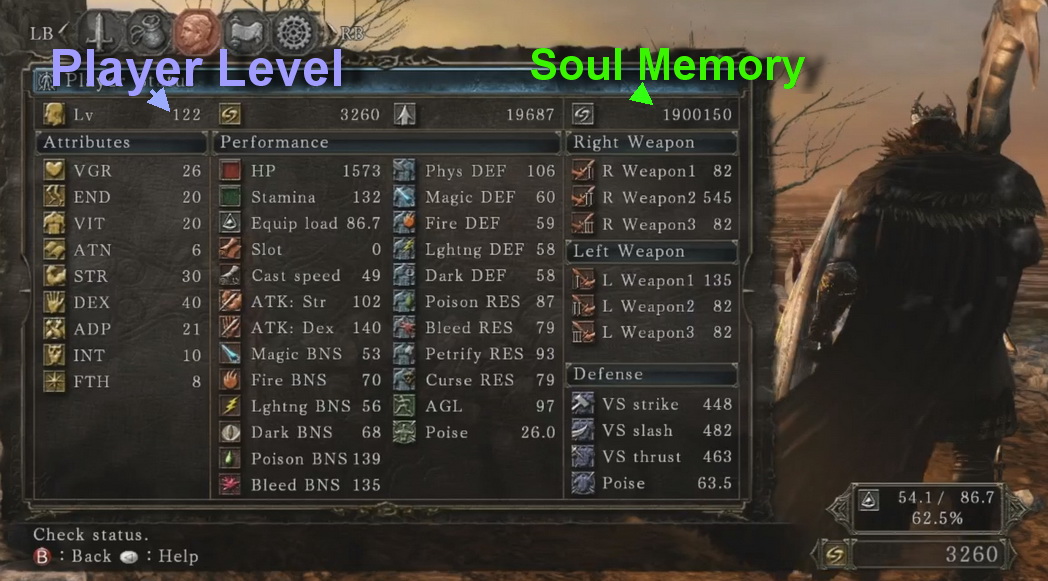
From Software’s B team has to be credited for constantly swinging for the fences, leaving no stone unturned and introducing several new, bold mechanics to the Soulsborne gameplay loop. Some of these innovations, like Bonfire Aesthetics and Life Gems, were rousing successes. However, Soul Memory is one such invention that did not pan out so well.
Soul Memory is the metric which determines if two players can play with one another. It is determined simply by how many souls a character has earned in their entire lifetime. Generally, players need similar Soul Memories, or the game will simply not allow them to invade or cooperate with one another. As Soul Memories grow and grow, the compatible range does get more lenient, but the rest of the franchise figured out well a much better way to balance co-op play than this. Demon’s Souls cuts the cooperative’s health in half, while Dark Souls 1 and 3 simply scale the cooperator down to around the host’s effective level when the two players connect. Dark Souls 2 simply does not allow connection between two players who are too far apart in Soul Memory.
The Infamous Earthen Peak Windmill
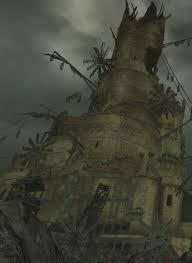
Let’s brainstorm for a moment. If I told you that a boss fight was coming up against an enemy who heals when it gets poisoned, is sitting in a giant body of poison in her boss room, and can have this body of poison almost completely taken away by exploring the map, what would you expect that would result in? How best would we drain a room full of thick, deadly, viscous poison? Put this article down for about 30 seconds and brainstorm some ideas.
What did you think? If you guessed anything other than “I must set this random windmill on fire, and this windmill being torched completely drains most of this entire building of poison”, you would be wrong. And you most likely were having entirely other thoughts on solving the problem too. If this is the case, the boss encounter with Mytha, the Baneful Queen may prove more frustrating and annoying than it needs to be.
Even From Software themselves must know how silly this was. When the rebooting of Dark Souls 2, by way of the Scholar of the First Sin version released, From Software added Devotee Scarlett as a summonable NPC and actually made her the only NPC in the entire game hard-coded to try and lead the player towards something, as she will actively try to have the player burn the windmill.
Frigid Outskirts
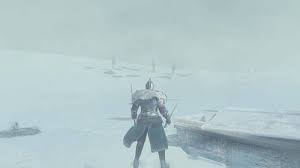
Amazingly enough, this area was actually designed by From Software’s main “A” team, not the “B” team responsible for the base game. Funny then that the Frigid Outskirts turned out to be not just the worst area in the entire game, but realistically the absolute biggest piece of garbage in all of Soulsborne. This area sucks because it constantly takes away the player’s ability to see, makes it hard to figure out where to go from where they’re standing, and spawns the most annoying, unfair enemies in the entire game to take advantage of them for it. It is as if the A team intended to piss players off with this one.
That’s about it, really.
Dark Souls 2 is my favorite game of all time. I have a very difficult time imagining any game ever usurping it in this regard, as even Elden Ring, while a magnificent game itself, didn’t do it for me in quite the same way. Referencing a past analogy, the “Andrew Baillargeon video game enjoyer” is giving this game an S+++ for a grade. The InReview writing version, however, will settle for giving it a well deserved A. While this game is niche to the point where I don’t know if I’d recommend it to everyone I’ve ever met, it certainly plays to that niche extremely well. Anyone enjoying any type of third person RPG at all, let alone a Soulsborne or Soulslike, will love Dark Souls 2. Hopefully, if you’ve read this and haven’t played the game yet, you will some day come to love it as much as I do.
Either way, if you’re experienced or new and looking to jump aboard the hype train for Return to Drangleic tomorrow, I’ll see you there!
 InReview
Leave a comment