
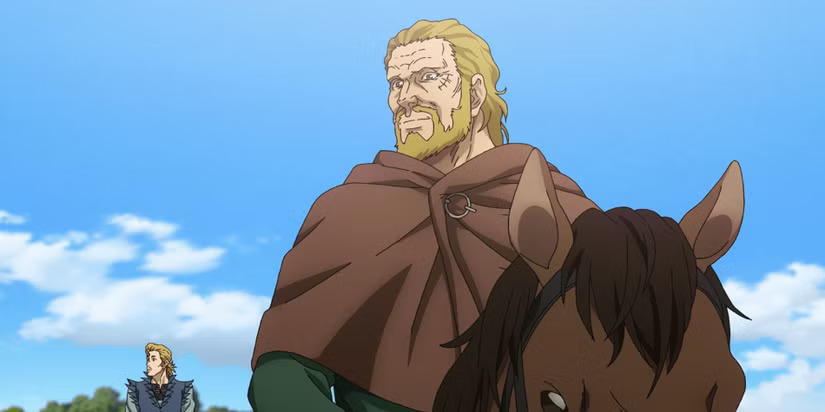
How can you be a good man in a system that is inherently evil? That’s the key conflict for Ketil, the generous yet cowardly farm owner from “Vinland Saga” Season 2 who buys series protagonist Thorfinn and his eventual best friend Einar.
Ketil initially shows both men mercy by allowing them a chance to buy back their freedom by working his land. And unlike stereotypical slave owners, he works the land with them and teaches them everything he knows.
But this image of Ketil cracks once you examine his motivations and how he treats people he doesn’t think he needs to show mercy to.
His prime victim is Arnheid, a married slave woman who also is his concubine. Unlike Thorfinn and Einar, she has no way to earn her freedom and we later learn she’s bearing Ketil’s child.
“Vinland Saga” doesn’t shy away from the atrocity of this situation, especially when Arnheid’s husband breaks free of her captors and tries to free her. She’s conflicted because she still loves her husband, but wants to protect her child. When she eventually loses both after a confrontation with Snake, Ketil’s mercenary, she has nothing left to live for.
Ketil is first presented as a good man corrupted by an evil system. What man doesn’t want companionship? And in this world and time period (11th century Denmark) it’s socially acceptable — even if it privately raises some eyebrows in the anime — to own a concubine.
But no one person should have that amount of power over another human being. And so Ketil is torn down by his inability to assert morality in a society that selectively enforces it.
Ketil is a wonderful villain because of how outwardly good he seems. He treats his men and even Arnheid well until she tries to escape. He wants to be loved, so he earns it from a community he builds.
But he does not have the moral fortitude to not participate in a system that is inherently abominous. For all his love and generosity, when Arnheid runs, Ketil reacts the same way any stereotypical slave owner would: He beats her.
And while his deal with Thorfinn and Einar seems generous, we have to acknowledge that our perceptions of it are warped by the Chattel slavery of the Americas, which was uniquely cruel. In the time of “Vinland Saga,” slavery wasn’t based on your race and those in servitude often were able to earn their freedom in their lifetimes.
Ketil knew that it was better to have Einar and Thorfinn as friends than enemies, and that by offering them a piece of his operation and a choice to join it willingly, they would have more motivation to help him. He showed them an act of kindness and earned their loyalty. But he had incentive to; if they grew discontent, they could have escaped or at least created serious trouble for Snake, the farm’s prime enforcer.
Arnheid posed no such threat. Ketil also didn’t want to be alone, so a similar deal was off the table.
There’s also the matter of his lie, which he pays dearly for when he thrusts his farm into battle with King Canute. Conflict exposes him as a corward and his impersonation of “Iron Fist” Ketil destroys the lives of his sons, Thorgil and Olmar. Thorgil becomes an uber-warrior — much like Thorkell in Season 1 — prepared to throw his life away for the farm, whereas Olmar is treated like a failure for having the same cowardly but kind heart of his father.
Ketil isn’t evil, but he isn’t a good person. He acts in his own self interest and uses mercy as a means to achieve his own ends. He’s not a sadist, but he’s no saint.
He’s human. And he folds under pressure only great men can withstand.
Men who have no enemies.


 InReview
Leave a comment