
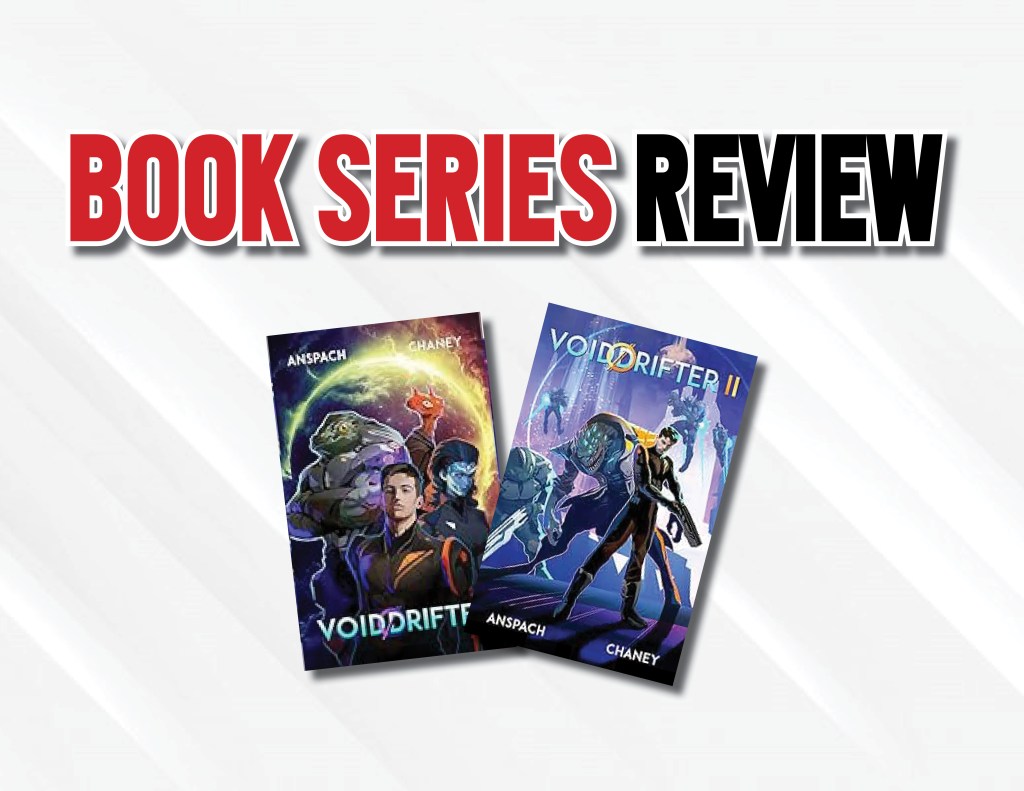
There is something about J.N. Chaney and his work that has kept me coming back to his literary worlds with childlike eagerness. I like to believe that he and his many co-authors who have built these respective works with him have produced a plethora of ones with very different flavors, even if some are closely related in theme. Such is the case with his latest series, Void Drifter, the product of a brilliant collaboration between Chaney and Jason Anspach.
While I have been whittling my way through Chaney’s Homeworld Lost, another tale of a human lost in space and his adventures with a crew of alien misfits (which I have previously reviewed),this one piqued my curiosity.




Now, having torn through the first two books of the Void Drifter series with gusto, I must say that it is a horse of a particularly different color from the prior series, despite its core similarities. Still, the basic level parallels between the two sister — or rather half-sister — works inevitably have driven me to make comparisons between them.
In Void Drifter, Anspach and Chaney add a level of sophistication to their work not found in its sister series. Taking place in the present day, rather than the near future of its counterpart, archaeologist Will Kaufman, while on a journey to a site in South America, encounters disaster when the pilot of his plane, falls unconscious due to a heart attack and crashes them in the middle of the jungle. While attempting to head towards civilization, Will stumbles upon a cave that leads to the Phaelon, a downed, yet still functional alien ship that crashed on Earth over four thousand years ago.
He awakens Quin, its long-dormant AI constructed from the mind of its former navigator. After dumping alien languages into his head, he takes off into the cosmos with Will as its hapless passenger.





In the greater galaxy, countless civilizations await, but with four millennia having passed, things are now very different and much more dangerous, with civilized worlds now being ruled by the iron hand of the Imperium.
Luckily, the Phaelon is a voidship, constructed with the ability to traverse the alternate reality that lies beneath space, giving it the advantage of speed. And though navigating its dangerous routes without falling victim to its eternal song is a rare ability, Will discovers that he possesses this gift, much to the chagrin of the sarcastic Quin, whose prior experiences with humans consisted only of primitive paleolithic tribes of millennia past.
It is Will’s gift that may save him and the Phaelon from capture from the Imperium’s despotic grasp, which has forced Quin to awaken the ship’s blue-skinned Astradian captain, Fera, and conscript two members of its cargo of captured criminals: Sert, a huge, pugilistic warrior of the reptilian Vorvak race, and Lockett, a cybernetic Drayth super-hacker with an almost fetishistic love of technology.
Though a neophyte to the galactic stage, Will must become a capable member of this ragtag and distrustful crew while helping them put aside their differences in order to survive, even as a light of hope is revealed via a remnant of rebels prepared to stand against the Imperium, which in turn threatens to crush even Earth in its grasp.





With this tale being cut from the same cloth as Homeworld Lost, and as I am currently currently two books into this series, I believe that I have gained a clear enough view of Chaney and Anspach’s writing to have a somewhat nuanced opinion on which one is better written. And though this in no way means that the other is bad by any stretch of the imagination, I have to say that Void Drifter wins this honor hands-down. For sheer dialogue, world-building, and characterization, Anspach illustrates masterfully specifics and details of the universe of dizzying technology and variety of species that Will encounters, giving life to the many unique locations, aliens, and cultural nuances that the lone human must learn to familiarize himself with in his journey.
Just like its sister series, Void Drifter hosts aliens of every shape, size, and temperament. Anspach’s clarity of description truly became a standout here, as much as it was something of a relief for me, since the description of the extraterrestrials in Homeworld Lost tended to be somewhat vague— a frustration for someone who truly enjoys sci-fi tales with a plethora of alien races.
It was also a joy to read, from Quin’s polite yet condescending manner, Fera’s no-nonsense attitude, Surt’s incessant thirst for ultraviolence, and Lockett’s overly-caffeinated IT guy demeanor, all told from Will’s wide-eyed, fish-out-of-water perspective, which never fails to annoy everyone else as often as it amuses Surt, who, after seeing Will’s prowess in a fight, develops a deep respect for him.
Will, on the other hand, having no history among these disparate races or their respective squabbles and prejudices amongst each other, which have persisted over four thousand years, proves to be the glue that binds—or at times forces—them together. Perhaps the only hitch to this was the very thing that made Quin so interesting as a character.







The Phaelon’s sentient AI is never without a witty retort, as well as some kind of disparaging remark against Will’s “primitive” nature as a human, often to the extent that I found myself wanting the snarky ghost in the machine to receive his own share of physical violence, were that even possible.
But this is counterbalanced by not only the crew’s growing confidence in Will, but also Quin’s grudging respect for the hapless human, whose talent for Void navigation forces him to see Will as an equal. As irritating as his barbs could be, I came to accept them as simply his attempt at good-natured ribbing, rendered more abrasive by having no filter.
Chaney and Anspach also excel at writing detailed, nail-biting fight scenes and action sequences that kept me riveted in a way that few other books have. Of course, none of this is to say that Chaney’s work with Moon is somehow deficient in Homeworld Lost; both it and its sister series present great action scenes that keep the reader hooked. Anspach simply does it better. From page to page, these sequences ratchet the stakes and weave Will’s interactions with his crew, internal thoughts, managing alien tech, and his struggle to stay alive, making me truly feel like something was at stake in every battle. Though on the downside, it can sometimes go on for a bit too long in a couple of places. The stakes and payoff, however, are well worth their length, as Will and his crew often have to fight understandably hard to obtain their objectives.
Another surprising element of character interactions and characterization that I noticed is something this story possesses that Homeworld Lost does not: Romance. I always considered it a shame that Chaney and Moon avoid any romantic interests between Noah Gantz and the female aliens he encounters in the aforementioned sister tale, whether among Kayan’s crew or in his travels, never moving beyond him viewing them as friends, extended family, or comrades in arms. But Anspach shows no such shyness, facing this head-on in Void Drifter with the growing affection that Will develops with Fera, whose defenses are eroded by his optimism and charm. Perhaps this stems from the hopeless romantic in me, but I found this plot development as fun as it was more realistic compared to the story’s counterpart.
To bring it all together, though Homeworld Lost has been around for a great deal longer, with twelve volumes available at the time of my writing this retrospective, and Void Drifter possessing only four, the latter weaves a story that is somewhat more concrete in the elements that make it up, better integrated, and slightly more interesting.
Nevertheless, I keep coming back to both for adventure in the vast reaches of space. Anspach and Chaney have made Void Drifter a perfect pairing for sci-fi space adventure enthusiasts whose appetite has been roused by one tale and is happy for more.
“Void Drifter” Books 1 and 2 get a 9/10. I highly recommended them.
 InReview
Leave a comment