
After finishing “Steins;Gate,” a time travel anime I consider a masterpiece, I was left wanting more. That led me to “To Your Eternity.”
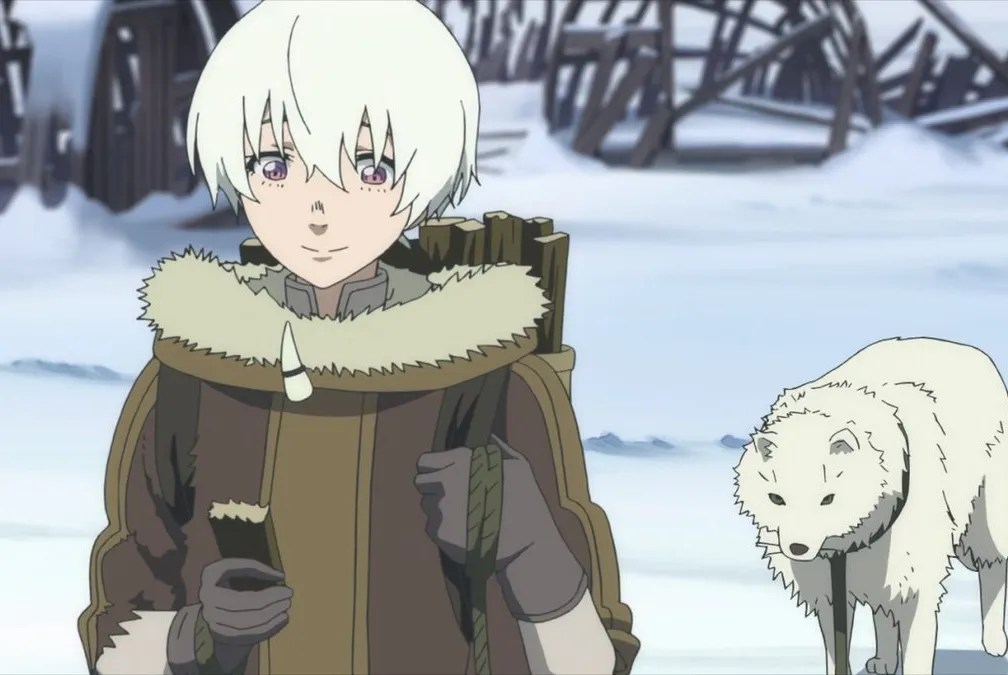
The show follows Fushi, an immortal being that starts out as an orb. When a wolf dies somewhere in the Arctic, he takes on its form and gains consciousness.
That’s the gift and burden of Fushi — he can take on the form of anyone he meets, but they have to die first. In a way, he is able to preserve his friends, but only superficially. He is able to become them and add their physical gifts to his arsenal, but he is unable to bring them back to life.
As such, Season 1 is stuffed with melodrama and fantastic characters whose time gets cut short just as we start to identify with them. There is no way to write about this show in further detail without spoiling at least the first season, so consider this your warning.
Among the characters we meet are an unnamed boy in the Arctic who was left behind when his tribe migrated. He stayed to look after the elderly, who are all gone now, and it’s not even clear if his tribe made it to their destination. He dies with a head full of dreams he’ll never be able to realize.
We then meet March, a young girl who wants to grow up to be a mother, but who is marked as a child sacrifice. She is protected by her older sister, Parona, and antagonized by Hayase, the warrior from the empire that is trying to kill her, who develops an unhealthy fascination with Fushi.
Fushi cannot die, so the greatest challenge of this series is to give him a villian that can hurt him in other ways. Series creator Yoshitoki Ōima’s answer to this is the Nokkers — semi-intelligent, fleshy creatures who want to kill humanity and are able to steal all of Fushi’s forms. However, once stolen, they aren’t gone forever — if Fushi is able to destroy the Nokker that’s taken them, they’ll return to him.
This creates interesting stakes for Fushi. He himself is invulnerable, but his friends aren’t. And so he evolves into a profoundly empathetic character.
In a way, Fushi is a stand-in for the viewer through the various stories Ōima lays out. He experiences the slow, painful death of the boy in the Arctic and decides to live out his dreams for him by taking on his body, which serves as his main vessel. He then is put right in the center of Parona/March/Hayase’s conflict, which ends in heartbreak, as March is eventually killed. Controversially, we later learn that Parona also meets her end, while Hayase lives on, albeit disfigured from a fight with Fushi, and ends up founding an order whose only mission is to court Fushi in hopes of stealing his power.
But the arc that might break fans is that of Gugu, Fushi’s sworn brother. Gugu grows up in some of the harshest conditions possible, being left to fend for his own first by his parents, then his brother. He then gets his face disfigured when he tries to save the daughter of a noble, whom he develops a lifelong love for.
Fushi enters his life when he starts living with the owner of a local liquor store simply named Booze Man, who is dating Pioran, an old lady who was imprisoned by Hayase, and who originally marked March to death. Pioran serves as a mother figure to Fushi, and her arc serves as a template for some of the show’s best characters; they start off as strangers to Fushi, even strongly disliking him at first. Then they become family.
The same is true of Gugu. He finds work with Booze Man and company, who are at first indifferent to him, despite the fact that Booze Man gave Gugu a mask to make him feel more comfortable and confident around people. Even Fushi seems to care little for Gugu, so much so that, when Gugu runs away, no one goes looking for him.

However, in his absence, the group realizes they miss him and can’t function without him, given that he serves as a the primary cook for the household.
The two then grow up together, and Gugu becomes a man. The everything comes to a head when the girl he loves, Rean, is set to be married to another noble. And then the Nokkers attack.
Fushi goes through this many times with new characters, with Season 1 wrapping up with a stint on a prison island where no one ever escapes, not even the children of prisoners. The loss of his friends there prove to be too much for Fushi, and he enters self-exile after Season 1, to prevent any more people from being killed by the Nokkers.
Season 2
Season 2 takes a drastic different turn, and I’m not sure how I feel about it. Season 1 is a melancholic tale that feels complete, if not satisfying because it does not end on a light note. You feel the weight of Fushi’s burden of immortality, as he is haunted by all the people he can’t save. All Fushi wants to do is talk to them again.
Season 2 builds off of that notion, and so, with more brand-new characters, it sees Fushi learn more about his origin (he was created by a mysterious cloaked man only he can see who appears in Season 1, but plays a larger role in Season 2), develop his abilities further, as well as acquire the vessels of those with supernatural abilities, including one who can talk to the dead.

Because it tries to cover so much ground, Season 2 is much less focused and a bit of a mess. It’s bursting with ideas of which it doesn’t show restraint to filter.
It’s also keen on giving us a happy ending, which I enjoyed, but it’s not as powerful as the cumulative grief Fushi feels at the end of Season 1.
Still, Ōima crafted an unforgettable saga that has one of the best depictions of an immortal character in fiction. Fushi doesn’t want riches, status or most of the things other anime protagonists strive for — he’s lost every friend he loves and he just wants to see them again. And because he serves as our point-of-view character, so does the audience.

It’s a credit to Ōima’s masterful job crafting flawed, likeable characters that become found family to Fushi. Most of their initial conflicts arise from a place of understandable distrust, given Ōima’s brutal world filled with bad actors like Hayase. But they each find mutual trust, love and respect for Fushi.
“To Your Eternity” is a beautiful series bolstered by bittersweet sadness. As such, it’s not for everyone, and if you stop at the end of Season 1, it might leave you feeling broken and directionless.
But that’s what makes it profound. Ōima doesn’t pull any punches and she’s willing to take risks other shows won’t with beloved characters.
Ultimately, that’s what draws me to anime: Its willingness to pursue storyline and narrative structures Western media won’t touch. When’s the last time a Western show had the protagonist become the villain in its last season? (i.e. “Attack on Titan”) Or successfully pulled off a series of heists, within a heist, within a larger heist? (“The Great Pretender”) Or successfully communicated the crushing weight of living the same day in which your friends die over and over? (“Steins;Gate”).

Yes, anime has its awkward, laughable moments. But it also take risks I seldom see taken elsewhere.
“To Your Eternity” routinely gambles with its characters successfully, though I admit it’s not everyone’s cup of tea. It is, at its core, a tragedy.
But it masterfully delves into the burden of never dying, why we love the people we do, what is means to keep their memories alive and the elements we can control in situations we can’t.
It’s well worth your time.
“To Your Eternity” Seasons 1 and 2 get a 9/10


 InReview
Leave a comment