

Domestic abuse is a really difficult subject to tackle in a wide release theatrical film. Tone is key — something too lighthearted will understandably be panned for not taking its subject matter seriously, while something too over-the-top can be seen as insulting to survivors.
“It Ends with Us” strikes a good balance. The film follow Lily Bloom (Blake Lively) as a young woman starting fresh in Boston, where she is trying to open a flower shop. She grew up in a small town in Maine, where many of her formative memories are tainted by domestic abuse committed by her father, Andrew Bloom (Kevin McKidd), who was also the mayor of her town.

While she still loves her father, Lily cannot forgive him for how he hurt her mother, Jenny Bloom (Amy Morton), even in death (he is deceased at the start of the film). In fact, this causes Lily to flee his funeral early in the movie after she finds herself at a loss for words during her time to speak at the ceremony.
This leads her directly into the arms of Ryle Kincaid (Justin Baldoni), a charming neurosurgeon with anger issues. She is initially resistant to his advances — likely due to the flashing red flags he exhibits in terms of his anger management — but she is quickly assimilated into his inner circle when she hires his sister, Allysa (Jenny Slate), at her shop.
Allysa becomes her best friend. Slate portrays her as a compassionate but often oblivious companion who often looks the other way in troubling situations. Her husband, Marshall (Hasan Minhaj), also serves as Ryle’s closest guy friend, but he has a negligible impact on the film. He could have been written out with very little impact to the film.
Ryle unfortunately shares too much in common with Lily’s father — he assaults’ Lily on multiple occasions. The film isn’t initially forthcoming with this — some might see this as a spoiler — but viewers should know exactly what they’re getting themselves into when seeing this movie. It frames each incident initially as an accident — likely a representation of Lily’s denial as she tries to accept Ryle’s gaslighting after the fact — but this fragile false realty crumbles when he seriously harms her.

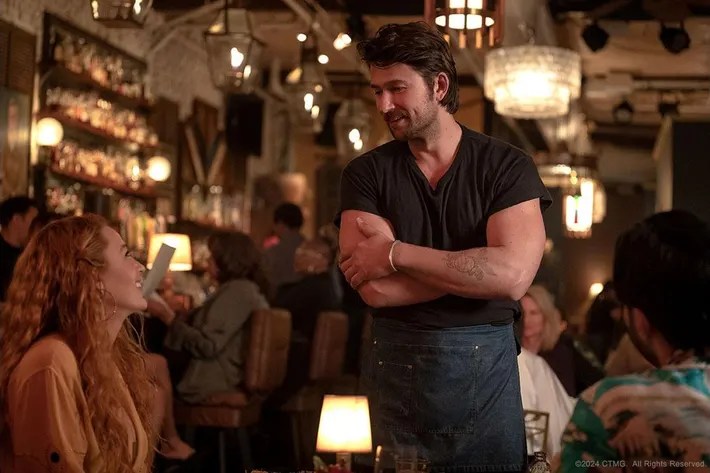
Lily’s ex-boyfriend, Atlas Corrigan (played by Alex Neustaedter as a teenager and Brandon Sklenar as an adult), serves as a major conduit from which Lily is able to escape this cycle of abuse. The two had dated briefly in high school when Atlas’ mother made him homeless, but they went their separate ways when he joined the military. Now, Atlas owns the hottest new restaurant in Boston, Root, which is where the two reunite.
Atlas is a complex person. He initially lies to Lily about having a partner and doesn’t introduce himself when they first eat there despite instantly recognizing him. He suspects that Ryle is abusing her, which eventually leads to a strange confrontation.
One of the film’s biggest weaknesses is its overreliance on happenstance and forced scenarios in order to manufacture its melodrama. To some extent, this can be excused — Lily hiring Alyssa, who happens to be Ryle’s sister, for instance — this is an unlikely scenario, after all. But it crosses the line when it intentionally has its characters go against their nature to make seemingly nonsensical decisions — like Lily ignoring Atlas after not seeing him for years when they first meet at his restaurant — in order to create emotionally charged scenarios.
Lily’s worst character flaw is when she lies or withholds critical information in order to avoid uncomfortable situations. While it makes sense to a certain extent that she would be avoidant, given she’s a survivor of abuse, she’s also an adult making very immature mistakes/ To make matters worse, the film’s liar revealed scenes are painful to sit through.
Yet, the movie handles its central premise remarkably well. Ryle isn’t necessarily an evil person — he has genuine love for Lily — but his inability to control his anger and his desensitivity to violence and manipulative nature makes him a dangerous person to be in Lily’s life. This is only exacerbated when the two marry and have a child together, linking them forever.
However, unlike her mother, Lily is able to break the cycle of abuse, which is where the film gets its namesake; “It Ends with Us,” meaning this vicious generational torment ends with Lily and her child.
What I think is remarkable about this story is the fact that Lily still has love for Ryle — she does not just reject him completely like a flat character would — but she also recognizes that they cannot be together romantically in any way.
Lively’s performance is fantastic and hits the nuances of her character well, including her timid and at times joyful nature. Baldoni serves as an excellent foil — the way his controlling impulses are gradually revealed is laudable and entirely makes the film’s initial portrayals of Lily’s injuries as accidents plausible.

For some, this film won’t go far enough. I admit, Ryle did get off pretty light — he shouldn’t be a practicing surgeon still with the option to coparent with Lily, he should be in jail. This is a pressing moral dilemma that the film glosses over — presumably, Lily chose not to go to the police so Ryle could still be in his daughter’s life to some extent, but we don’t know for sure. Her arc is resolved when she chooses to leave Ryle, with what’s next for him left up in the air.
Still, this is an admirable, nuanced take on this subject matter. It’s not perfect — its production values are on par with a film made for Netflix and outside of Lily and Ryle, none of it characters have much depth. But it’s also compelling and thought provoking — well worth a watch.
“It Ends with Us” gets an 8/10




 InReview
Leave a comment