
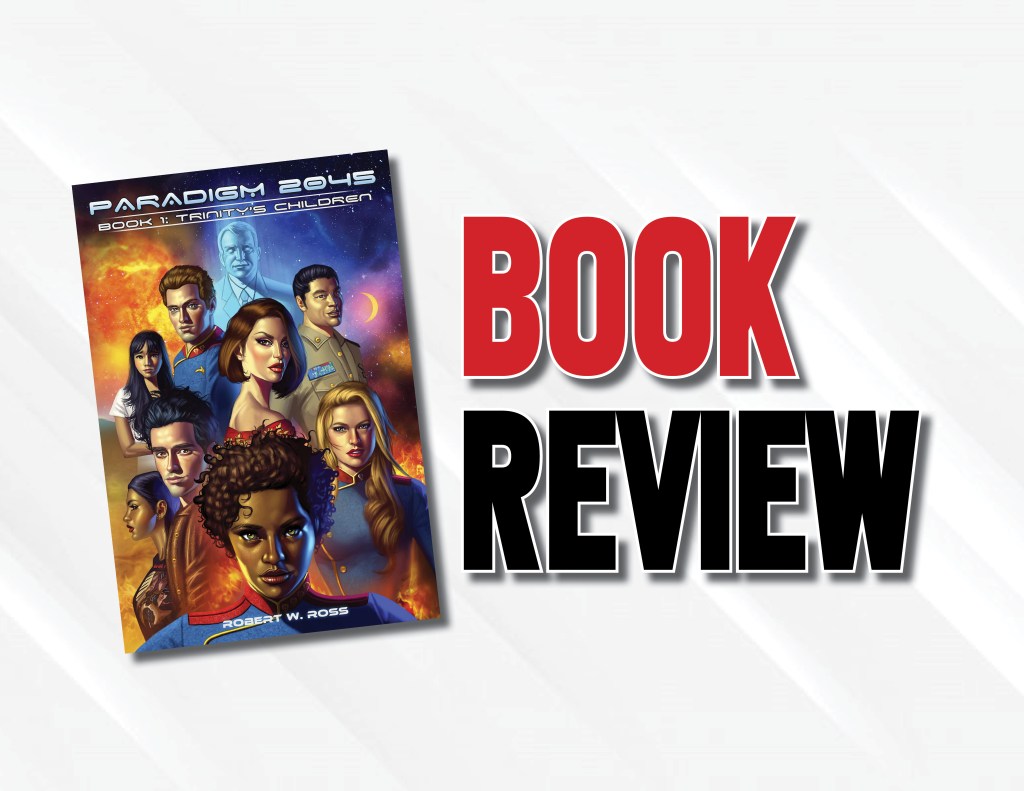
Lately, there have been a growing number of books—especially those in the sci-fi genre—that are becoming steadily less subtle with their references to their sources of inspiration. And while this may be something of an annoyance to many readers, Trinity’s Children, the first book in Robert W. Ross’ Paradigm 2045 series, seems to avoid any pitfalls of insipidity.
The story begins in 2004 with a discovery made by the obscenely wealthy and unusually long-lived Dr. Damien Howard, with the aid of his A.I. companion, Coleman, on his 131st birthday: They manage to decode a signal from space from an alien ambassador.
Trapped in a precarious situation due to her having violated interstellar laws to aid Earth in its first contact, a simulacrum of this alien intelligence informs Howard that, after learning of humankind’s splitting of the atom, Earth has been given 100 years to develop faster-than-light travel. Should humanity fail this test and all after it, Earth will be deemed a threat and all human life will be rendered extinct via a powerful pathogen.
With only 41 years and perhaps less time left in his unusually long life, and with the wealth of several nations at his command due to his financial fingers in too many international pots to cout, Howard sets in motion a grand endeavor to not only build the perfect ship to meet the alien ambassador’s challenge, but to create the perfect crew as well. However, all of these projects are set to be accomplished long after his death.
The story then jumps 41 years later in 2045 (after Howard’s death), with only months left until time runs out. Charlotte Omandi, a famous humanitarian from Kenya, is contacted by Coleman and Howard’s chief of security, Misha Sokolov, and is whisked off to his estate, much to Omandi’s chagrin.
There, she finds her purpose, and though initially reluctant, Omandi steps up and proceeds to gather the crew for the final test, knowing that she will either usher in a new era for humanity, or doomsday.
First of all …
So.
Many.
Pop.
Culture.
References.
Not since Ernest Cline’s Ready Player One have I read a book with so many name drops to elements of current and past pop culture, particularly science fiction movies and TV shows from the 70s, 80s and 90s, and for good reason. Fortunately, unlike Cline’s seminal work, Ross does tone it down a bit, with the references being kept to a level that does not induce nausea. Still, they become key parts of the story, from character interactions to the names and designs of uniforms and even ships, making for a good time for fans of these sundry IPs.
The cast steadily grows throughout the book’s race against time from country to country, gathering the potentials for the crew that will pilot the ship that will save the world. Howard’s eccentricities live on after his death and play a strong role in keeping various milestones concealed until various calculated points in the quest are reached, exposing everyone to surprising twists and turns that are fueled by the personality quirks of each new crewmate and their interactions. International powers also desperately pursue Omandi, Sokolov and Coleman, seeking access to Howard’s estate and alien-enhanced technology for their own nefarious purposes.
The characters’ unique quirks is the most enjoyable thing about the book.
Each character’s own unique quirks are most enjoyable. They transform Omandi’s growing crew into the perfect somewhat dysfunctional family, from the analytical first officer Chao, to the brash and outspoken pilot Branson, the deeply empathic Linnea, the high-strung Karishma, compassionate doctor James, and Misha’s blunt and somewhat paranoid nature.
Ross is a master at making each and every cast member believable and complex. Their interactions are intense, natural, and often deeply moving, generating a great swell of sympathy and even love for them all, and a hope that they will make it through this gauntlet of strife and quickly winnowing time. It is their individual talents that bring them safely through every challenge, even in the story’s darkest moments.
Even more captivating is the story’s use of evolutions of current and even still experimental technology, but keeping it in a manner that makes it commonplace. In addition, the plot is not at all predictable, with danger at every corner, and even some truly astounding plot twists near the story’s harrowing end, where the fate of the Earth truly feels at stake with every turn of the page. And even after all is said and done, a much bigger world is hinted at for the further books in the series, which I personally will be certain to read.
Trinity’s Children is the beginning of a space opera with a cast that makes the reader feel right at home, and a tense, action-packed plot that ends at a point that hints at the fact that after all that has happened, it is still only the very beginning. Readers of this unique subgenre looking for something different to lead them into a grand adventure, yet with a high tolerance for constant sci-fi pop culture references would do well to pick this story up for a read.
8/10; highly recommended.
 InReview
Leave a comment