
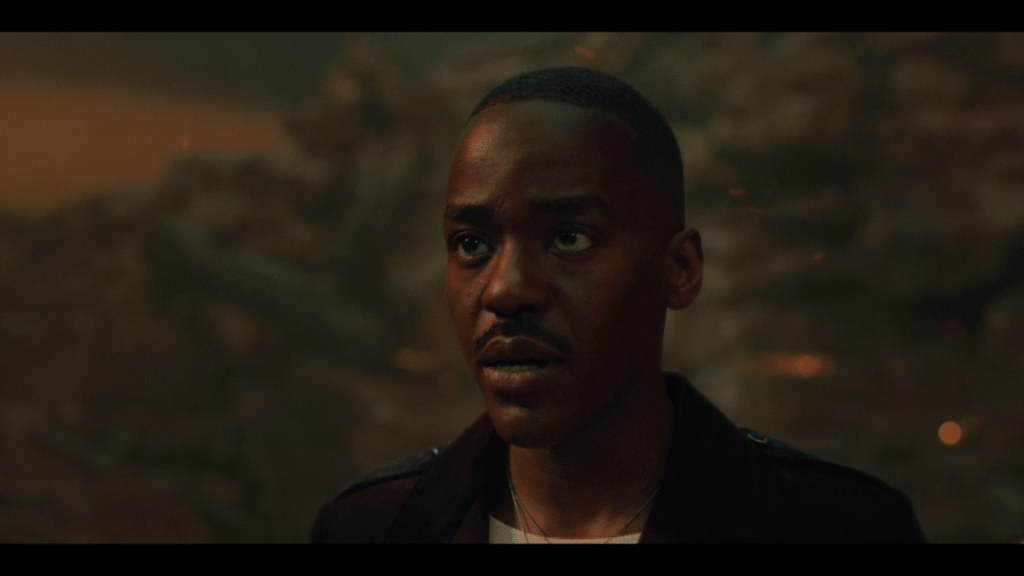
After finally getting through Jodie Whittaker’s run as the 13th Doctor last year, I was cautiously optimistic for Ncuti Gatwa’s tenure as 15. David Tennant’s short return as the 14th Doctor was quite good, and I loved Gatwa’s first full episode as the ageless Time Lord, so it appeared that better days were ahead for my favorite sci-fi show.
So far, I appear to be right in that assertion. Three episodes in, and showrunner Russell T. Davies and Gatwa are blowing Whittaker and her showrunner, Chris Chibnall, out of the water. Doctor Who is back, hopefully for good!

Episode 1: Space Babies
Rebranded as Season 1 in order to get new fans on board, in its first episode, “Space Babies,” the Doctor and companion Ruby Sunday (Millie Gibson) find themselves on a space station in the far future run entirely by talking babies. It turns out that the station they’re on created the babies, and the people who made it abandoned it. It serves as a convenient segue into introducing the Doctor as an orphan to new viewers. As such, we also get an obligatory introduction of the show, which glosses over the events of “The Timeless Children,” but does not negate them.
Episode 1 works because of its unexpected turn; the Doctor emphasizes with the monster of the episode, which was created by the space station solely to scare the babies (it wanted to tell them a real-life bedtime story). The Doctor smartly realizes that the monster did nothing wrong — it doesn’t even harm anyone — and doesn’t deserve death even though it is designed to be unlikeable.
The special effects for the space babies was a tad disturbing, but that’s my only real complaint with the episode, other than its gimmicky nature. It’s a solid introduction to what it sure to be a weird season of TV.
Episode 1: “Space Babies” gets a 7.5/10

Episode 2: The Devil’s Chord
“Doctor Who” is king of throwaway lines that are either never followed up on, or are decades later. Remember when the Toymaker told the 14th and 15th Doctors that his legions where coming for him? This episode deals with one of them.
Maestro (Jinkx Monsoon) is a god-like being like the Toymaker who operates outside of the rules of the universe. Maestro gains entry into this world through a misunderstood genius in the 1920s who finds the missing “devil’s chord” in a famous composition, after which the villain kills him and proceeds to try to absorb all of the music in all of time.
This episode get a little timey-whimey as it interferes with the past and present without getting into alternate universes. But it’s made completely by the trio of Monsoon, Gatwa and Gibson. Monsoon is an unpredictable force of nature whose moods changes constantly. Because Maestro can only be defeated by twisting their own rules, like their father, the Toymaker, they have the Doctor on the ropes for the entire episode — a theme of this season.
Gone is the Doctor who sweeps in last minute to save the day or who can make an army run at the sole mention of his name. Davies has humbled the Doctor and in doing so, added stakes that have been missing from this show for a very long time.
Gibson is also brilliant, as her character walks this line of having innocent curiosity and still looking at the Doctor and the TARDIS as this amazing thing, while realizing that his adventures are deadly. Sooner or later, she’ll likely realize that the danger isn’t worth it — if she survives.
This episode also makes good use of a Beatles cameo (the Doctor and Ruby learn of Maestro because their music is gone) that doesn’t dominate the episode like Chibnall’s did.
This feels like a midseason finale. More please.
Episode 2: The Devil’s Chord gets a 9/10

Episode 3: Boom
Who let Steven Moffat write an episode?
If you thought this was going to be an easy, boring season you are mistaken. Episode 2 was already a rollercoaster; Episode 3 is like a kick in the balls.
This episode sees the Doctor and Ruby travel to a planet in the future previously though to be uninhabited. Instead, they find people in the middle of a war with an enemy they’ve never seen.
At the core of this episode is Villengard, a vastly powerful arms company whose sick algorithm determines who lives and who dies — its job is to keep casualties “acceptable” for clients. We see it work firsthand when it unnecessarily kills a blind man who would require 4-weeks’ recovery time.
The Doctor spends most of this episode standing on a landmine, trying not to set it off. It serves as an engine for Moffat’s excellent character-driven writing between Ruby, the Doctor and some of the planet’s inhabitants (including Varada Sethu as Mundy Flynn, who will replace Gibson as the Doctor’s companion next season).
Moffat does take things a bit too far. Without spoiling anything, a key character dies briefly who definitely shouldn’t have. Come on Moffat, you’re going to scar these new fans!
With that being said, it is still a solid episode and it gives me more than enough confidence in Gatwa’s Doctor. He’s good at one thing every Doctor actor should be at: monologues. I think the show has a bright future in his hands.
Episode 3: Boom gets a 9.5/10


 InReview
Leave a comment