

After watching and reviewing “Hazbin Hotel” Season 1, I watched its pilot. After my TikTok reviews netted thousands of views in a very short time, it was clear that this show already had an established fanbase and I wanted to see where it originally all came from.
The “Hazbin Hotel” pilot was released in 2019 on Vivienne Medrano’s YouTube page and has some notable differences from the show, prime of all being that the voice cast and the personalities of its characters. The style of animation and character designs have also been tweaked in the TV show.
The pilot follows Charlie Morningstar (Jill Harris), princess of Hell, who is pitching her Hazbin Hotel (then named the “Happy Hotel”) idea in which sinners within are redeemed to her people. However, unlike in the show, where nobody believes her and thinks that she’s delusion, but ultimately respect her position of power, a few characters have little to no respect for Charlie and outright laugh in her face.
I think the show struck a better balance in this area, as the pilot sees a TV news anchor outright get into a fight with Charlie on a newscast with little to no regard of the consequences. The show highlights well that, while most denizens of Hell don’t see Charlie as a threat or take her seriously, they certainly see her father, Lucifer, in this light.

This also touches upon how the pilot portrays another person who laughs in Charlie’s face — fan favorite Alastor (Edward Bosco), the radio demon. In the pilot, he calls Charlie’s dream “kookie nonsense” and is an outright threat to Charlie as he almost immediately tries to trap her into a deal in exchange for helping her run the hotel. Show Alastor has so many more layers to him, as he’s a father figure and mentor to Charlie who genuinely wants her to succeed, even if his own motivation for doing so is to ride her coattails and gain influence through her.
I also think that Alastor’s radio-distorted voice sounds better in the show. His voice in the pilot sounds more faithful to an old radio broadcast, but it’s monotone and gets old really fast. The show again finds a better balance of paying homage to this concept while also allowing Alastor a suitable level of intonation and tones that makes him a much more enjoyable character to watch.
Angel Dust (Michael Kovach), the porn star demon who’s the hotel’s first resident, is also greatly inferior in the pilot version. He’s just outright mean in the pilot, whereas in the show, he’s a tortured soul who has been trapped in a cycle of addiction and has gotten trapped into selling his body to the overlord Valentino. In the pilot, he seems to care about no one outside of himself, but in the show, he shows genuine care for his friends.
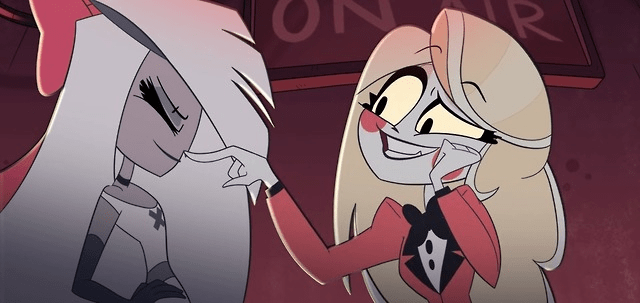
Vaggie (Monica Franco), Charlie’s girlfriend, seems to have a more active role in the pilot than in the show, but it comes at the expense of Charlie’s agency. Charlie is passionate about her idea, but is constantly being pushed by Vaggie to make it happen in the pilot, whereas Charlie is the main driving force for her hotel in the show.
Sir Pentious (Will Stamper) perhaps got the biggest upgrade in the show, as he goes from a pathetic and generic supervillain who is the show’s greatest comedic gift, to an admirable and heroic figure. In the pilot, he’s just a generic supervillain with gadgets and minions and worse of all — he’s not funny.
Husk (Mick Lauer), the hotel’s bartender, and Nifty (Michelle Marie), the hotel’s maid, are also in the pilot, but they’re in it so briefly it’s hard to make any substantial comparison.
Overall, I do prefer the style of animation in the pilot, but I understand that the production likely had to streamline things for the show, which utilizes a more rigid Flash style of animation. But that’s where my preferences for the pilot end; the show is better in every conceivable way, from its voice acting to its character arcs, characters and musical numbers — the latter of which come off as awkward and out of place in the pilot. The show has some genuinely good numbers mixed in with a few forgettable ones, but the good ones are a major draw for the show.
If you’ve watched the show, do you need to see the pilot? Not at all. Its differences are so vast, this should not be considered canon. If anything, it’s an interesting example of how a show can change in five years between its concept and finished product. “Hazbin Hotel” really made good use of its development time, improving upon its base to produce a show with remarkable potential I hope it fully realizes in future seasons.
 InReview
Leave a comment