

“Godzilla Minus One” is the antithesis of the modern superhero blockbuster. It’s grounded, it has great characters who are given full and fulfilling journeys and it looks incredibly sharp despite having a minuscule budget of less than $15 million.
In fact, I’d say this film looks better than any of Marvel’s recent films boasting $200 million budgets. “Godzilla Minus One” is a technical wonder in terms of knowing exactly where to spend its money and the exact amount of spectacle to show its audience. It’s not a lazy corporate product shot entirely on a green screen — it’s one of the few films I’m interested in watching the “making of” featurettes on because there’s a clear and skillful amount of craft behind this film.
The film takes place in 1945 at the tail end of World War II on an island off of Japan named Odo, where Kamikaze pilot Kōichi Shikishima (Ryunosuke Kamiki) is coming in for a landing, feigning mechanical issues with his plane. He doesn’t fool technician Sōsaku Tachibana (Munetaka Aoki), but before he can be shamed for abandoning his suicide mission, Godzilla attacks the island.
All but Shikishima and Tachibana die. Shikishima has an opportunity to shoot Godzilla with his plane’s gun, but freezes up, leading Tachibana to blame him for the death of his comrades. Godzilla appears to be a juvenile and much smaller than later in the film and even though viewers know a machine gun won’t do anything to the titanic lizard, Shikishima doesn’t know that, and he carries that guilt with him.
Shikishima goes home to Tokyo after the conclusion of the war to find his family dead and his home in ruins. He lives initially hopeless in a makeshift shack, until he runs into a woman named Noriko Ōishi (Minami Hamabe), who he finds trying to steal food for Akiko (Sae Nagatani), an orphaned baby whose parents perished in the bombing of the city.
The three become a found family, with Shikishima and Norika serving as Akiko’s parents. Shikishima eventually finds work as a mindsweeper diffusing naval bombs in a rickety wooden boat whose crew includes engineer Kenji Noda (Hidetaka Yoshioka) and Yōji Akitsu (Kuranosuke Sasaki), the ship’s captain. The work is dangerous, but pays well.
Noda and Akitsu serve as father figures to Shikishima in different ways. Noda is inquisitive and open-minded — like a professor — whereas Akitsu is very traditionalist but is openly critical of the Japanese government, particularly its use of censorship. The group gels when their boat encounters Godzilla in 1947, who has grown significantly. Shikishima has proved himself capable as their sniper (in order to diffuse the mines, they need to shoot them) and they successfully manage to evade Godzilla, but not after he’s destroyed two battleships. This brings an overall sense of dread and hopelessness over Shikishima, and a notion that his war isn’t over yet.
His attachment to the past weighs him down, preventing him from pursuing a formal relationship with Noriko and he suffers nightmares about Godzilla and the men he wasn’t able to save on Odo. Godzilla keeps attacking Japan, which puts him on a collision course with the giant lizard as he seeks redemption for his cowardice back on the island.
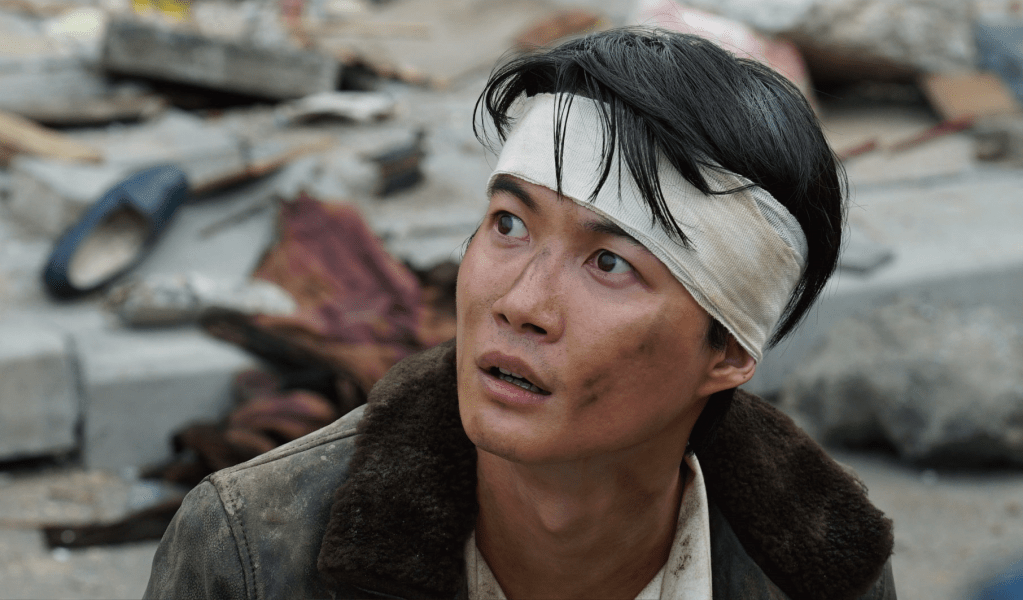
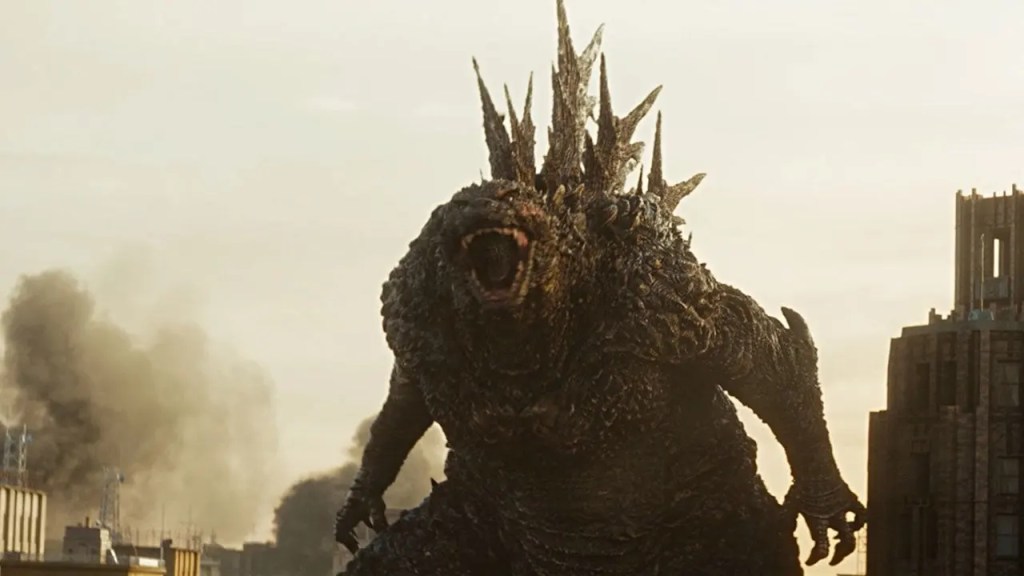
Godzilla looks great in this and while he is only in it for a handful of sequences, he makes a devastating impact in the film every time he’s on screen thanks to the excellent work writer/director Takashi Yamazaki and the film’s cast put into developing these characters. Shikishima is very relatable as he had very normal reactions to impossible circumstances, but his society demanded that he be a martyr. The film itself is critical of the idea of kamikaze pilots through the characters of Noda and Akitsu, who denounce it and Japan’s lack of regard for human life, as they criticize it not only for the program, but also for poorly armored tanks and planes without ejector seats during the war.
Tachibana and Sumiko Ota (Sakura Ando), Shikishima’s neighbor who initially ostracizes him for surviving his kamikaze mission, represent well the traditionalist viewpoints about the program, but even they come around and realize that it’s better for Shikishima to live than to throw his life away. Tachibana eventually comes back to help Shikishima fight Godzilla and has a small but powerful arc, whereas Sumiko eventually grows into a mother figure for him, Noriko and Akiko, helping them raise the girl when the pair are off at work.
The film culminates into a final sequence that is inspiring and well-executed. After the Japanese and U.S. governments fail to deter Godzilla, Noda comes up with a plan to tie flotation devices with Freon gas around it, sending the king of the monsters into a deep trench, before using a separate device to bring it to the surface, using the forces of rapid compression and decompression against it.

It sees every major character team up against the monster, finding strength in unity, and almost everyone has a moment when they shine. The film completely destroys Shikishima — and through him, the audience — before building both up in a massively satisfying way.
This is a Godzilla film you might cry during — that’s how good these characters are. “Godzilla Minus One” is a mightily entertaining film with themes that transcend its monster movie roots, as it’s a shockingly good anti-war film with intelligent commentary on Japan’s kamikaze program, rugged individualism and ultimately, the value of community and human life.
Even non-Godzilla fans will love this film. It’s easily one of the best films of the year.
“Godzilla Minus One” gets a 9/10



 InReview
Leave a comment