

In late August, the highly anticipated movie based around the iconic Texas Chain Saw Massacre movie franchise released. This asymmetrical survival horror game was developed by Gun Media and Sumo Digital, a pair of development teams responsible for the likes of Friday the 13th, Hood: Outlaws and Legends and more.
Development had been undergoing for nearly two years. Does it quite make the cut? Let’s take a look at the game, covering what it does and doesn’t do so well as per usual. Let’s start with what the game does well on.
Viewer discretion is advised. Topics discussed address graphic content that could upset, offend or startle readers.
Attention To Detail
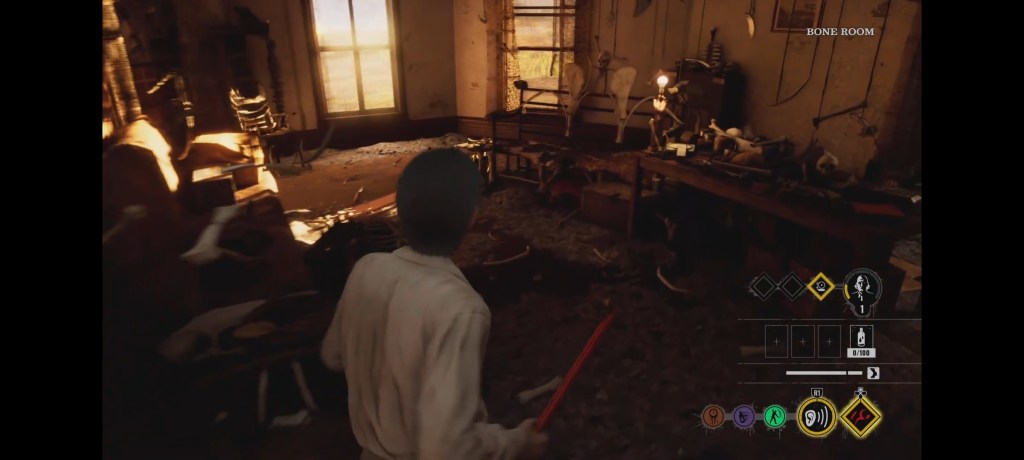
The Texas Chain Saw Massacre is commonly, mistakenly thought of as being entirely based on true events. This is only partially accurate. The concept of Leatherface is loosely based off of a real-world serial killer known as Ed Gein. Gein himself was no cannibal and he didn’t wield a chainsaw, but what he did do was wear his victims’ skin on his face similarly to Leatherface. Something else he did was create furniture out of the bones of his victims, an environmental trait seen in droves across the franchise.
The Ed Gein inspiration is very much acknowledged throughout this game. Not just that, but structures such as the Family House or Gas Station look as if they’ve been pulled right from the movie source itself. Everything, from the “meat” BBQ inside the Gas Station, to the aforementioned bone-crafted furniture inside the Family House, even the perfect replication of the sledgehammer Grandpa uses in the movie, really does a good job emulating the movies within the game itself. This helps to create a very authentic, unmistakeable experience and gives the game solid identity.
Balance
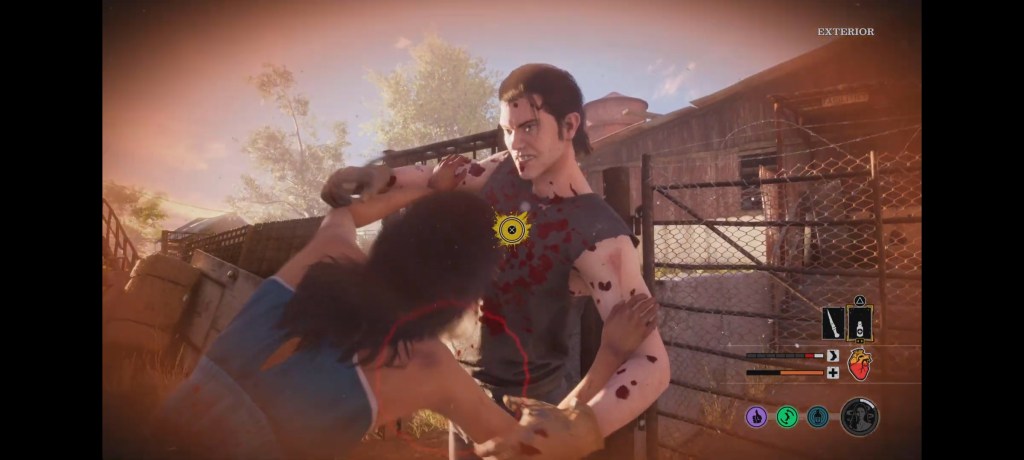
Ultimately, though a subjective topic by nature, the game is in a much, much healthier state from a balance perspective than it was during the Technical Test. There are definitely individual, specific traits of the game that are probably themselves not terribly balanced, but overall, the game scarcely ever feels like the lesser of the two sides is winning just because of a faulty game mechanic or overpowered perk or ability of sorts. Unless you’re on the Gas Station’s “secret exit”, that is…
During the forecast of the game published on InReview, specific issues were highlighted such as The Cook’s inability to be viable without active voice communications, an agitating issue with permanent door slams and the notion that the Victim Connie was vastly superior to her fellows. The Cook does still have some problems operating without voice communication to an extent, and Connie is probably still the best Victim in the game, but those extremes have been toned down significantly for the better. As well, door slams were thoroughly addressed and, barring a bug or glitch of sorts, should never be an issue that resurfaces again.
Although few view this game as being particularly competitive, at the end of the day, nobody likes losing. If you’re up the creek without a paddle from moment one just because someone picked a character that gives them an advantage, no match or game will be fun to play. As a result, it was good to see balance get a lot of attention before the game went live.
Player Identity/Skill Expression

As has been said here on InReview before, skill expression is an informal term used to label players who attempt to compete using their own, original and creative ideas to craft a ‘build’ or setup in general. This ties in to player identity- if you prefer a workhorse type character who can stick around for the long haul, you will probably gravitate towards the Victim Ana. If, on the other hand, you prefer a faster paced do-or-die type playstyle where you either escape or die in minutes, a character like Connie or perhaps Sonny would fit you better. Likewise, those who enjoy chasing more than patrolling or supporting will aim to play as the Family member Sissy, whereas those who prefer more of a floor general-esque supporting role will go for The Cook or perhaps Johnny.
Character selection isn’t even close to the lengths of this game’s skill expression. You can outfit The Hitchhiker to also be an effective Blood Harvesting character, to help progress Grandpa’s power more quickly. Alternatively, you can invest skill points into his admittedly low Savagery skill, so that he might not be able to help much with Grandpa, but he will be able to end chases more effectively when they’re started. Similarly, maximizing the Victim Julie’s Stealth can make it easier performing noisy actions quickly, but if you’re alright with scrapping that advantage, you may prefer to increase her Toughness to allow her to survive being chased more consistently.
There is no ‘right’ answer, except for fitting to your playstyle, as there are ultimately well defined pros and cons to anything you may try and do. Said pros and cons give more weight to player decision making, make a player identity more distinct, and lead to the game being deeper than the sum of its parts.
The Texas Chain Saw Massacre is not a perfect game. In fact, at the time of writing this article, the game’s very first patch released recently has caused a pretty enormous series of problems. Let’s analyze its shortcomings.
Crossplay and Anti-cheat
On Tuesday, September 5th, this game saw its first patch. It didn’t address much of anything to do with actual gameplay, with the main highlights stemming from crossplay and how lobbies work. For the former, PC players were controversially removed outright from being able to play with console players on the PlayStation and XBox. The reason for this stemmed from within the game’s paper-thin anti cheat that was being exploited frequently, mostly by PC players. The result was a massive exodus of the game’s playerbase; Steam allows players to earn full refunds on games where developers made notable structural changes to the game within a short time after release. What that has culminated into is a precipitous cut of 53% of the game’s peak playerbase, going from just under a 15,000 active peak to slightly less than 7,000 at the time of writing this article.
Of course, games are going to drop off in player count when the shiny new toy syndrome fades away. But they do not drop off to this extent. Logically, people who went to the trouble of getting a refund are unlikely to come back to this game. As was discussed previously, this game likely has a very limited shelf life to begin with and definitely did not need to hasten its own demise.
While crossplay changes have proven irksome to the broader community, lobby changes were felt for more than just PC players as well. The time for lobbies to remain open before a game begins was doubled, and games were now being allowed to begin with one player short of a typical game capacity- games could now proceed if the Family only had two players, or if there were only three Victims. Longer waiting in lobbies plus a pretty damning lack of regard for what the game was balanced around predictably were not warmly received.
Progression


Progression operates off of a fairly simple system. There is the ‘Player Level’, which is an accumulation of all games you have played as both The Victims and The Family. Each time a Player Level increases, the player earns Skill Points which they can use on any character of their choosing. Characters also have their own ‘power’ as well as perks which can only be leveled up by playing that specific character – this is independent from Player Level entirely. As the player puts more and more Skill Points into a given character, that character’s Character Level increases.
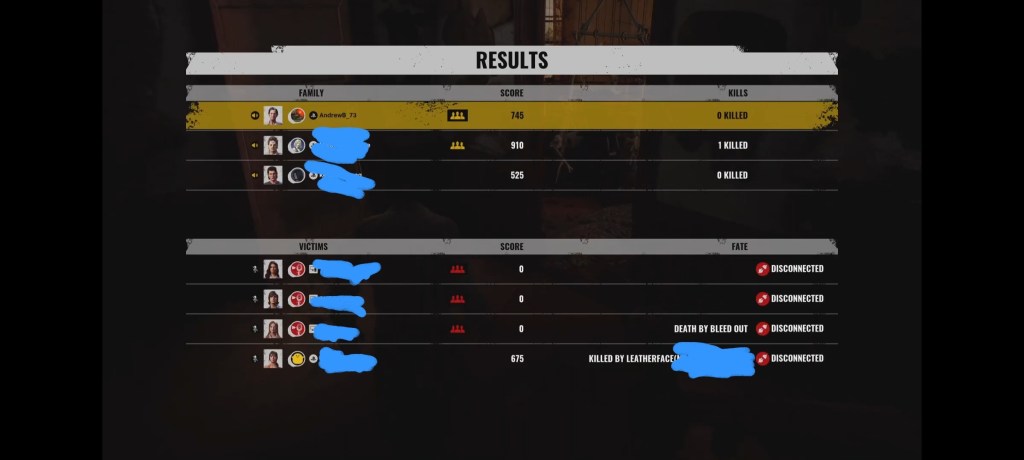
Progression is very slow right now. Attached above are pictures I took of my account when earning the What will be left of you? PlayStation trophy, which is earned for playing a total of 74 matches. After 74 matches, I had accumulated enough Skill Points to bring a few characters on both sides to a mid level, while being forced to neglect other characters entirely. If the average match is around fifteen minutes, that’s roughly 1100 minutes or, just shy of nineteen hours of playtime.
There is a big difference, predictably, between a character at Level 10 and a character at Level 0. Because this game does not allow two players to play as the same character, it can become quite frustrating to the point of disintegrating lobbies entirely if a player chooses to maximize one character instead of build multiple characters at the same time. The problem with that comes when the requirements to advance Player Level grow higher and higher as the player goes. That can make the process of developing characters out to be quite tedious.
At present moment, it is also quite easy to exploit the game’s Respec system. If the player Respecs a character, any Skill Points used on that character will be returned to them, to be used on anyone they’d like. It’s easy to Respec a Level 10 character, leave them at level 0, bring another to level 10, then rinse and repeat when the player wants to use someone else.
To balance both ends of the spectrum, Respeccing a character should only grant Skill Points to be put right back into that character. In return, it could be a good idea to encourage players to play other characters by introducing ‘dailies’- for example, picking a certain amount of locks using Connie’s power in one day could grant one or two Skill Points which can be used specifically on Connie. This wouldn’t disrupt progression too, too much, but it would give players a reason to play other characters, and it would reward certain skillful play and help to foster repeat use of said play.
Social Environment

Gun Media and Sumo Digital want this game to be very teamwork oriented. There’s game chat, it’s a team based game, and given how objective-heavy it is, clearly it was designed with team coordination in mind. Despite this, game chat is completely unregulated, giving credence to players saying terrible things to each other; being harassed somehow, whether it be with excessive racial or homophobic sentiment or other slur words, is very common. Worse yet, it is currently not possible to mute players until the game has started, giving players several minutes, possibly more, to berate other players unchecked.
When the actual gameplay starts, there is little to stop players from exhibiting other anti-social traits. Examples range from simple taunting to cheating and even to ‘sandbagging’ or, intentionally sabotaging teammates in some way.
In order to entice players to actually play the game and interact with each other, there needs to be far more in terms of chat regulation. As well, even smaller actions such as “teabagging” or other forms of anti social behavior need to be made as close to impossible as can be.
Between the lack of anti-cheat, very questionable decision making regarding crossplay, and the inability to setup a proper social environment for what’s supposed to be a very socially engaging video game, it is worth questioning if Gun Media and Sumo Digital possess the skills and leadership to make The Texas Chain Saw Massacre a genuinely successful game. As the game operates on an ultimately niche IP with no practical hope for expansion, it has already largely been viewed as a game with a clear expiration date. At present, the game is fun enough at a surface level to stay relevant for the short term. However, the only thing that’s happened since launch is constant reinforcement that it’s not built to last.
As such, The Texas Chain Saw Massacre gets a C for a grade.


 InReview
Leave a comment