

Final Fantasy 16 recently released to a chagrin of middling reviews. People who expected more of a challenge from their game. Sure, the Final Fantasy community didn’t figure the game to be the Dark Souls of the franchise per se, but some encounters are won ridiculously easily, and the game feels like a bit of a Cutscene Simulator at times.
Want something a bit more engaging? A game that’s challenging, but not absurd? If so, the remastered version of “Final Fantasy 12: The Zodiac Age” may be just what you’re looking for. Today’s review aims to analyze the game, with the typical “what it does well” and “what went wrong” tidbits. Let’s begin with the former.
Balthier
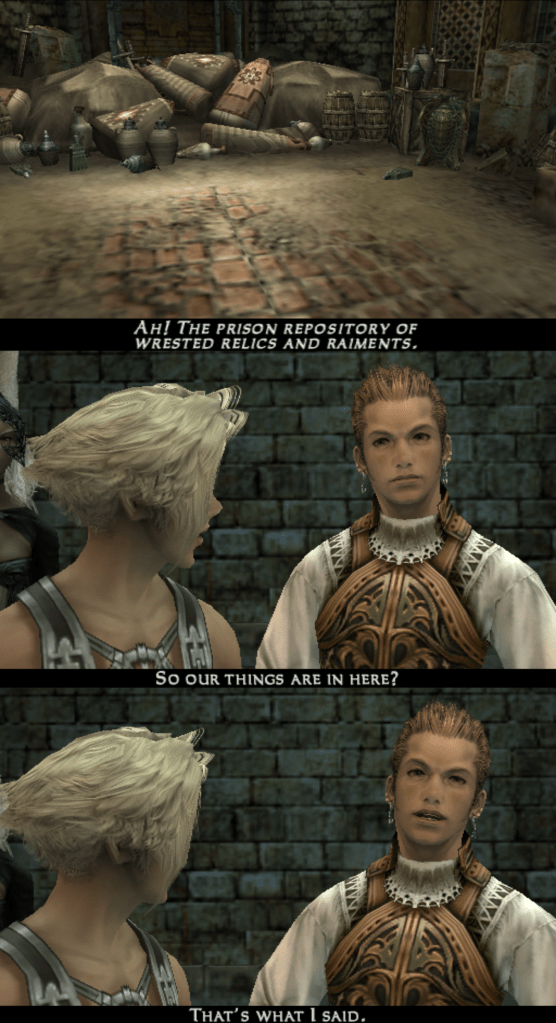
By a million miles the best character in the entire game, Balthier is perfect for this game in every way conceivable. As a tool to push the plot, his “brave, but not stupid” shtick does a great job progressing the game, without doing anything over-the-top. Apart from that, his silly but serious demeanor makes his interactions with the rest of the cast memorable. Voiced by Gideon Emery, even mundane lines nobody would bat an eye at seem important and interesting when it’s Balthier reading them. Balthier has plenty of not so mundane lines that made a lasting impact on the game, mainly when accepting payment to help a major character on a brutally long journey, admonishing Vann over him saying something stupid to Fran and, my personal favorite, the masterful “spare us your quiddities!” line that’s just oozing with personality.
Balthier masterfully gives this game both the edge and the comedic relief it needs. He may be one of the best, most well designed characters I have personally seen in a video game.
Gambits

Talking more about the meat and bones of the game, the Gambit system really allows this game to stand out from other RPGs. Gambits are essentially the player pre-conditioning their characters to use certain maneuvers in specific situations; you can set a Gambit to cause your healer to automatically cast healing spells of certain potencies depending on how low health their allies fall on, you can tune your mage to cast single target or AoE spells depending on the quantity of enemies, and you can have your characters conditioned to use items on a dime to cure the many nasty status ailments in this game. You have a dozen different Gambits that can be ordered in terms of which the player would like to prioritize more; you can set a katana-wielding character to spam attacks against a boss as your second Gambit, but keep a Gambit up top in case any of the character’s allies die, and they need to use a Phoenix Down immediately to help out.
In the game, the player will have anywhere from 3-4 allied units on the field at once, and they can control one of these units manually. Having the others function on their own, but function in a way the player directly intended them, is definitely the best part of Gambits.
This system is absolutely masterful, as it gives the player limitless strategic potential. It gives this game as a whole a lot of skill expression and serves to almost guarantee that no two players experience the game the same way, and no two play throughs of the game are quite the same. It keeps the game fairly slow paced, as if to emulate turn based content, but it also allows the game to be live-action in practice, which speeds the game up without overwhelming the player.
General Game Content
The main story of the game is fairly decent in length, but there is a metric ton of “side content” almost to the point of achieving meme-worthy status over how “extra” the game is. Seriously though, this is a beefy game that, nowadays, is fairly cheap or even free depending on your circumstances. You will get plenty of bang for your buck here, even if you don’t get side-tracked too often. But if you do, it’ll be a cinch. Hope you don’t have too big of a backlog!
Gilgamesh Boss Fight

Talking about a more specific aspect of the game, Gilgamesh is an optional boss fight found when the player has progressed the game enough and has completed a fairly high amount of ‘requests’. Gilgamesh is a recurring character in the Final Fantasy series as a whole. That said, it’s not too surprising Square Enix put a lot into making his encounter in this game memorable.
The mechanics of the fight are incredible. It starts off as a “gank” fight of sorts, as Gilgamesh is joined by his pet wolf, Enkidu. Enkidu and Gilgamesh are extremely threatening for very different reasons, so the player is encouraged to take out one of them as soon as possible, naturally. In this case, Enkidu is generally the one who will go down first, and when that happens, Gilgamesh gets a lot stronger.
Gilgamesh is very powerful. He comes to the table with a few different spells which inflict very nasty status effects, he generally hits quite hard being an end game boss, and uniquely, he has two cinematic attacks which will deal major damage when used: Monarch Sword and Bitter End. When used, the cinematic of Gilgamesh attacking as he shouts “SWORD, SHIMMER! SLICE!” or “FACE MY WRATH!” are endlessly entertaining, even after he uses these attacks for the 20th time in the fight.
Overall, this boss hits it right in the wheelhouse in terms of being a decent challenge, while also being thrilling cinematically and even fairly humorous as well. He is definitely the game’s best, most well designed boss and even though he’s optional, new players would do very well to experience his encounter.
Old School Charm

While it has some downsides, when getting remastered, this game’s mid-2000s level charm was not lost in translation. There are some pretty extreme mechanics, such as X-Zone straight up removing a character from the game entirely until the next checkpoint, rare enemies and loot with amusingly tedious spawn conditions or being able to spend money instead of MP to cast spells, effectively allowing your mage to spam their deadliest spells without any real brainpower at all times. There are also some instances in this game where it seems like the developers just threw stuff at the wall until something stuck; boss fights that require the player to heal the boss to win, major side bosses randomly hidden in the armpit of a side area, and boss fights which take literal hours to win. In the modern era, mechanics which are harsh on the player or give them too much room to breathe are a lot fewer and far between. In some cases, especially in multiplayer games, volatility can be more of a curse than it is a blessing. Here, it tends to work to this game’s benefit more often than not. It really serves as a reminder that you are playing an old school game with old school rules that simply runs more efficiently and looks nicer as a result of modern hardware.
World Building

The land of Ivalice is very deep. It is clear Square Enix did not leave any stone unturned combing over ideas for fresh, new areas and gimmicks for said areas. While there are a couple of exceptions that will be discussed, the world in general feels vibrant, active and independent of the player. Even side areas, such as the Nabreus Deadlands or Salikawood, have very distinct aesthetics, dynamic enemy variety and generally play quite well.
As far as the story goes in terms of world building, it is a bit confusing but does a great job laying out the framework for the player to explore the game with. It becomes very clear, very quickly, where the player should go to progress the game, areas the player can go to acquire various materials, or areas where certain enemies or items can be found.
Sadly, this game was not perfect. Let’s analyze what it falls short on.
Yiazmat Boss Fight

This will be a controversial discussion topic amongst the fanbase, certainly one the community will be divided on. In truth, Yiazmat is not the single worst boss in the game by any stretch, but this was definitely a lesser instance of the developers ‘throwing stuff at the wall until something stuck.’
Yiazmat, fought in the base game, has 50 million HP. This is by far the most in the entire game, and second place clocks in at just less than nine million. Already, even if Yiazmat were to stand still and do nothing, his exorbitant health bar means you are going to be here for a long, long time.
Yiazmat has a built-in mechanic where, even if his attacks don’t do too much damage, they have a small chance to simply insta-kill their target, even if they were close to completely full health themselves. This random insta-kill isn’t exclusive to Yiazmat himself, but considering how absurdly long this fight will be, the player will rack up a ton of deaths even if they managed to get the strongest, most powerful gear in the entire game for this fight. This is probably the worst part about the fight, as the game essentially punishes the player for existing in this sense.
Perhaps the back-breaker for this boss fight would be the laughably paltry “reward” the player receives for finally slaying him. Essentially, the player will get an insignificant amount of money, which by this point in the game is probably useless anyway. They’ll also receive an absolutely worthless piece of ‘loot’ they likely won’t even be able to do anything with just yet and, when they do, it will culminate into a weapon which can be acquired much, much more easily.
Yiazmat’s HP should have been cut in half, at the absolute least, and the automatic insta-kill mechanic needs to go- this would’ve made this fight much, much more acceptable.
The Great Crystal

This labyrinth of a map takes what makes a layout confusing and exacerbates it way, way too much. Here, the player’s map will become effectively useless, while their mini-map will be disabled. The pathway down The Great Crystal is not linear in the slightest, and can be extremely confusing. To make things worse, there’s no ‘fast traveling’ out, so if the player wants to leave, they’ll need to completely retrace their steps back to the entrance. The experience isn’t fun- it’s one of those ‘extreme’ mechanics mentioned earlier that didn’t hit the mark. Fortunately, the majority of the area is entirely optional, including the worst parts. However, hidden deep inside is an encounter with a powerful side boss and a very, very powerful spell. Plus, when the best that can be said about an area’s layout is “oh well, at least it’s optional” then you know it has not been a terribly fun time.
Necrohol of Nabudis
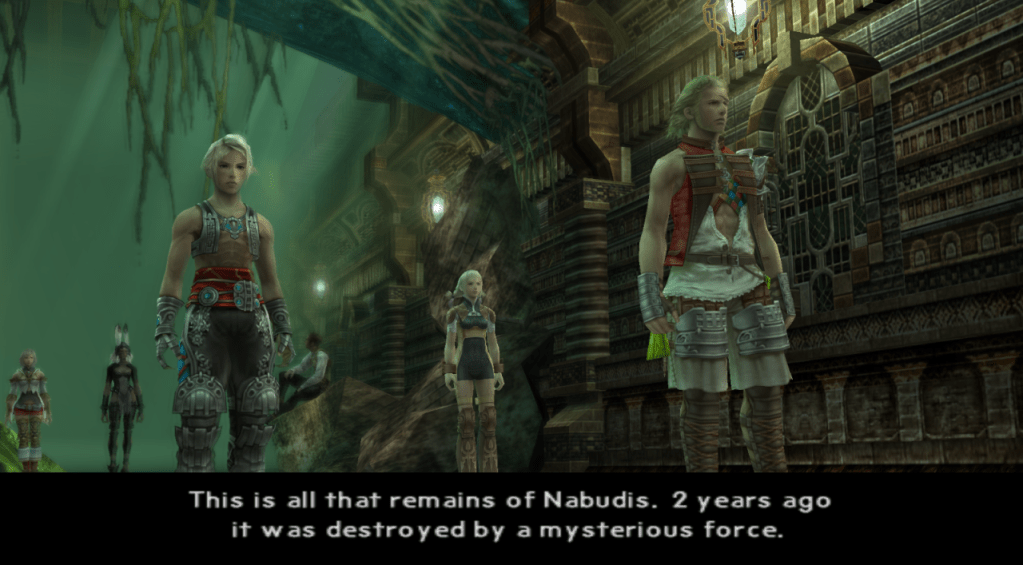
This area is fortunately much smaller and easier to navigate than The Great Crystal. Still, it includes irritatingly cheap mechanics that lack conceivable counterplay. After clearing a mob of enemies, an Oversoul enemy will likely appear- this enemy’s one duty is to cast Annul and completely drain the MP from its target. This attack cannot be dodged, blocked or redirected, and considering it will happen multiple times before a powerful side boss who has clearly not been balanced around fighting MP-less characters, it feels pretty cheap. As well, the dungeon harbors Baknamy enemies, who have access to the Death spell. As the name implies, Death simply insta-kills its target, and there are a lot of Baknamy in this dungeon. Overall, it thankfully is optional and is fairly short to get through, but what little content Necrohol of Nabudis does offer is content you’d do well to clear as fast and painlessly as possible. Or just avoid entirely.
The following was a topic I did not feel belonged under ‘good’ or ‘bad’. Let’s say this one is more polarizing; you will likely either love or hate it, and neither reaction is necessarily wrong.
The Story
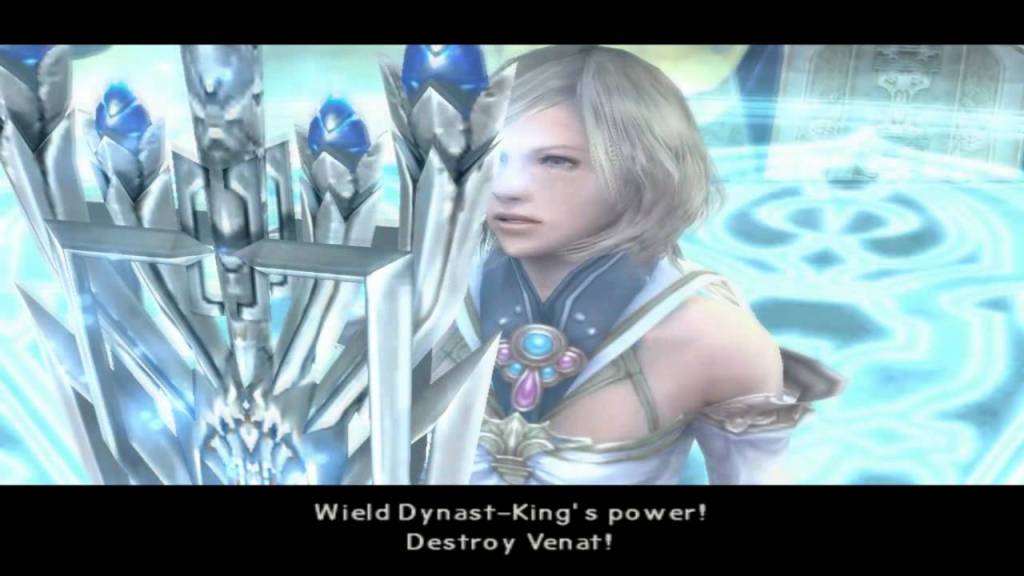
Yeah, turns out there’s a story buried somewhere under all the dead dragons, skeletons, dinosaurs and such you’ve been killing by the late game. The story is easy to lose track of, because it’s generally hard to follow and stay interested in. What it does provide can be interesting if you bother to follow along, but even then, it feels like a watered down Star Wars plot. It is very political and at times seems to want to venture into broader military strategy, but overall takes predictable turns.
The ending was definitely well done. Unsurprisingly, Balthier is almost entirely, even exclusively responsible for this.
Overall, this game deserves a grade of a B+. It can be enjoyed both by the casual, time-strapped player, as well as the obsessive completionist who turns over every stone. Given that the game is quite cheap, I’d suggest it to just about anyone.
 InReview
Leave a comment