

There is no doubting what director Christopher Nolan is capable of; he is perhaps one of the last great auteurs left in Hollywood, a shrinking group of directors that include the likes of Steven Spielberg, Martin Scorsese and Quentin Tarantino (I also include Edgar Wright on that list). They are directors who leave their mark on any project they touch, whose vision is the major draw of any film they’re involved with.
But they are not invincible or without flaws.
Nolan’s latest feature, “Oppenheimer” — based on the life of the father of the atomic bomb, Dr. J. Robert Oppenheimer (Cillian Murphy) — is very hard to process. Hot off the heels of 2020’s “Tenet,” Nolan has crafted a similarly experimental film whose runtime clocks in at three hours and whose narrative structure is nonlinear.
Those two factors work mostly against the film, though its nonlinear storytelling does provide compelling moments of juxtaposition, often adding important context and weight to actions in the past all but the most eagle-eyed viewers might otherwise miss. Still, it must be said that this film is simply too long — Scorcese was able to make three hours work with “The Irishman,” but Nolan’s film completely loses its focus at several points, feeling unwieldy.

This film covers the bases of Oppenheimer’s early life, giving a brief attempt to show how he sees the world in a similar manner to the Stephen Hawking biopic “The Theory of Everything.” This leads up to his fascination and later obsession with quantum mechanics that takes him on the path to making the atom bomb. There is a lot of chatter about the science behind the bomb, but what takes center stage is the political web that was behind its creation via the Manhattan Project.
Oppenheimer and Gen. Leslie Groves (Matt Damon), his superior, serve as Nicky Fury figures, assembling the best minds Oppenheimer can find from the United States and its allied nations to come to the secret government-built town of Los Alamos in New Mexico made specifically to test the bomb. There is very little conflict within Oppenheimer before the bomb is made; he is convinced that the U.S. has to make it or else the Germans will, which is fueled by a letter from his colleague, Albert Einstein (Tom Conti), warning of it. In fact, Oppenheimer’s internal conflict about the bomb only surfaced after two were dropped on Japan — he feels like he has blood on his hands.
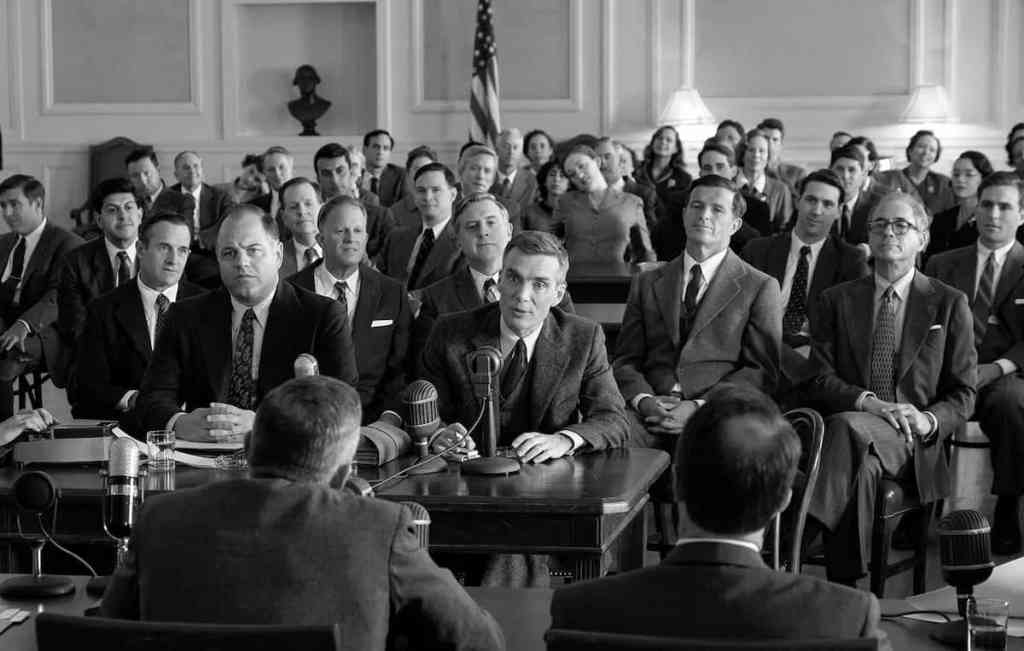
The moral ambiguity of the bomb’s creation is one of the strongest aspects of the film, one that should have gotten more screen time over boring Congressional hearings and meetings that often become redundant in the scope of the narrative. I think three-hour films can work, but they need to work extra hard to maintain the focus and attention of the audience throughout. “Oppenheimer” is filled with narrative fluff — 40 minutes to an hour could have been cut out, and the film would have been sharper and better for it.
Part of the film’s problem is that it juggles two major plots — the creation of the bomb/Oppenheimer’s moral crisis and reaction to it, and Lewis Strauss’s (Robert Downey Jr.) persecution of him after the war.
Strauss is the film’s antagonist, though he’s only revealed as such after hour two. He recruited Oppenheimer to head Princeton’s theoretical physics program when he was on its board, then served as his boss when he was chairman of the U.S. Atomic Energy Commission. He outwardly appears on Oppenheimer’s side — even capitalizing on his relationship with him when it’s convenient — but he ends up sabotaging his career by organizing a kangaroo court handpicked by him to revoke Oppenheimer’s security clearance over his past ties to the U.S. Communist Party (he fell victim to McCarthyism). It’s through Strauss’ cabinet confirmation hearing that the film is initially framed and we meet Oppenheimer, and it is through that lens that we learn of how America repaid him for his service during the war.

Both stories are important to understand the life of Oppenheimer, but it’s unfortunately a balancing act Nolan fails at. The hearing simply takes up too much space and overshadows the creation of the bomb and Oppenheimer’s activism after World War II, drastically reducing the impact of the most powerful moments of the film, where he reflects on what he has made with gravity and horror. Because so little time is dedicated to showing what type of influence Oppenheimer had after the war, we also don’t fully understand why Strauss was so eager to clip his wings, which is absolutely critical for his narrative thread.
The technical aspects of the film aren’t worth talking about — it’s a Nolan production, so it looks good, but 90 percent of it is uninspired shots of people talking in rooms, though he does play with color (or lack thereof). That puts the legwork of the film on its script, which as mentioned before, is rife with fat.
“Oppenheimer” is above average despite its flaws thanks to a strong performance from Murphy and a handful of really powerful sequences and ideas that will stick with you, like Oppenheimer’s parallels to Prometheus and his many character flaws (he’s an emotionally-unavailable man who lets down those he loves but is driven by a complicated sense of duty). It’s an edit away from greatness, but falls painfully short.
“Oppenheimer” gets an 8/10


 InReview
Leave a comment